
Browse Items (87 total)
Sort by:
ET4 Elkhorn Tunnel

Employees stand inside the Elkhorn Tunnel during construction. The 7,100 foot tunnel opened to rail traffic in June 1950, replacing a single-track tunnel constructed in 1887.
ET3 Elkhorn Tunnel

Construction of the Elkhorn Tunnel in Mercer County, West Virginia. The 7,100 foot tunnel opened to rail traffic in June 1950, replacing a single-track tunnel constructed in 1887.
ET1 Elkhorn Tunnel

Two workers stand inside the Elkhorn Tunnel during construction in Mercer County, West Virginia. The 7,100 foot tunnel opened to rail traffic in June 1950, replacing a single-track tunnel constructed in 1887.
RVNH40310 Henry Street Bridge

A snowy birds-eye view of the Henry Street bridge.
RVNH40250 Virginian Railway

Virginian Railway Engine No. 127 in Roanoke.
FE236 N&W Shops
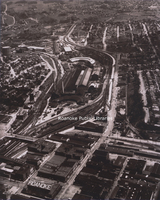
Aerial view of Norfolk & Western east end shops.
FE094 Old 97
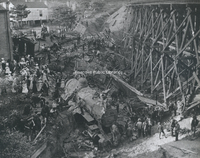
The wreck of the "Old 97" was an American rail disaster involving the Southern Railway mail train, officially known as the Fast Mail, while en route from Monroe, Virginia, to Spencer, North Carolina, on September 27, 1903. Due to excessive speed in…
FE089 Old 97
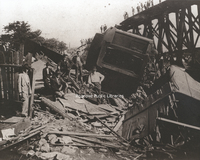
The wreck of the "Old 97" was an American rail disaster involving the Southern Railway mail train, officially known as the Fast Mail, while en route from Monroe, Virginia, to Spencer, North Carolina, on September 27, 1903. Due to excessive speed in…
FE086 Old 97
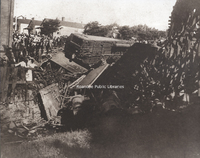
The wreck of the "Old 97" was an American rail disaster involving the Southern Railway mail train, officially known as the Fast Mail, while en route from Monroe, Virginia, to Spencer, North Carolina, on September 27, 1903. Due to excessive speed in…
HNWR160
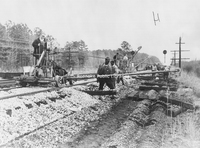
Here is but one example of how mechanization assisted significantly in the maintenance of tracks. A machine removes cross ties for the crew.
HNWR153
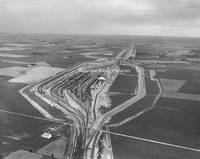
An aerial view of Bellevue Yard in Ohio, looking east. The classification yard is at left center and immediately to the right is the car repair facility. In the distance are the receiving and departure yards.
HNWR104
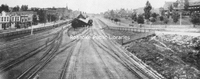
This view shows the early Roanoke passenger station (center),the N&W office building (center right), and the Hotel Roanoke (right).
HNWR044
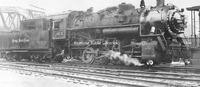
This history of the Nickel Plate Railroad is an amassment of histories from other lines, such as Lake Erie and Western, Clover Leaf, and the Wheeling and Lake Erie. The Nickel Plate was officially the New York, Chicago, and St. Louis Railroad…
HNWR038
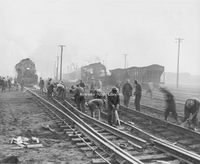
This photograph shows track crews at work along the N&W line. Track laying and maintenance was an awesome undertaking, given the thousands of miles of track owned and operated by N&W. Only in the middle part of the 20th Century did track work…
HNWR028
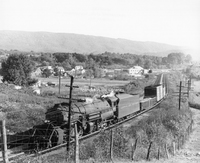
Engine No. 2165 is northbound near Waynesboro, Virginia, hauling a small but varied freight load.
HNWR026
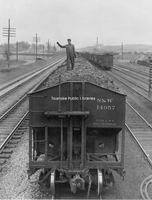
A hopper with coal is ready to go. 1970 was the peak for N&W coal traffic, when the railway carried 90.6 million tons of coal. While coal was profitable, it was not always a source of revenue. Floods, miner strikes, and other labor disputes cut…
HNWR023
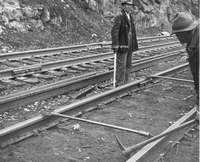
A foreman gauges track to make certain the distance between the rails is exactly 4 feet, 8 inches. In 1883, the N&W operated primarily on a 5-foot gauge; however, on June 1, 1886, the N&W and other southern railroads adopted the now-standard gauge…
HNWR021
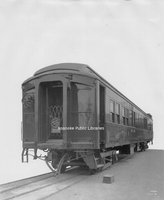
In the late 1920s, the N&W developed a new strategy in rail safety education - the motion picture car. Carrying the "Safety First" logo, the car traveled various rail lines of the N&W as a mobile classroom for the purpose of providing safety…
HNWR019
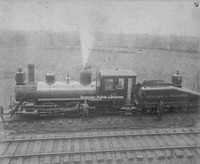
This photograph was taken at east Radford coal wharf. It depicts Engine No. 138 and crew. Mr. Akers, engineer; Charlie Roby, fireman; Mr. Allen and Mr. Adkins.
HNWR013
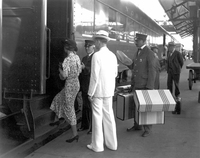
Passengers board an N&W coach. Passenger service when into a steep decline after the mid-1940s. In 1946, for example, the N&W carried 3.4 million passengers. By 1950, that figure was about 900,000. The automobile was taking its toll on the…
HNWR012
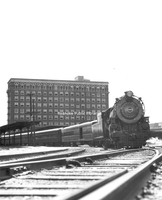
Engine No. 500 pulls out of Norfolk with the Pocahontas. The Pocahontas' maiden run occurred on November 21, 1926, when she ran between Norfolk and Columbus, Ohio. That run replaced the former "Norfolk-Chicago Express".
HNWR011
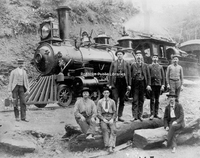
This photograph of the crew of Engine No. 82 was taken when Goodwin, West Virginia was a western terminus. The engine was standing on the Wye track. Crew members are S.D. Clowers, engineer; R.S. Brown, engineer; James Emmons, fireman; George…
HNWR010
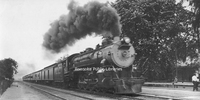
An N&W passenger train speeds between Roanoke and Christiansburg, Virginia. The N&W provided extensive passenger service through southwestern and southeastern Virginia, the Shenandoah Valley, West Virginia, and into parts of North Carolina. With…
HNWR009
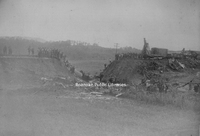
On July 2, 1889, a night storm swelled Wolf Creek near Thaxton, Virginia, which rose out of its banks just as passenger train No. 2 was crossing. The situation became N&W's first major disaster. There was only one survivor, trainmaster James…
HNWR008
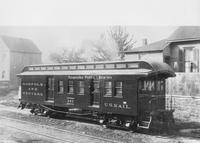
An early N&W mail car. The N&W purchased the car, which was built in 1892. Railroads were a popular and effective way to distribute mail around the country. Clerks aboard the cars would actually cancel the letters en route with the initials RPO,…
HNWR006
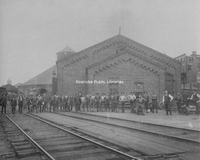
Employees at the N&W roundhouse in Lynchburg. While Lynchburg served as the divisional point for the N&W during its first few years, increased coal and ore traffic caused the N&W to move its divisional points farther west in 1888.
HNWR005
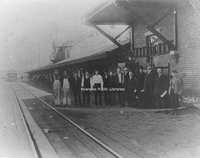
Here is the Old Yard Office located upstairs from the N&W Passenger Station at Radford. Pictured from right to left are Zince, Stump, E.E. Allen, Lawrence Allen, Louis Lucas, Horace Price, Tom Heslep, H.A. Hall, J.C. Turner, O.C. Charlton, J.H.…
HNWR004
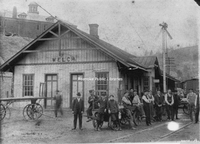
This photograph captures the station and crew at Welch, West Virginia. It is believed that the building in the background is the courthouse. Notice the freight car to the left.
HNWR003
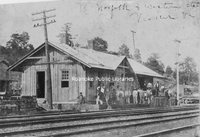
The carpenter crew has almost completed work on the station at Vicker, Virginia in this photo. Carpenters built everything from depots to boxcars and cabooses, to the finished interiors of passenger coaches.
SR180 Memphis Special

“Memphis Special” made its debut through the Roanoke Valley on June 20th, 1909, running between Memphis, Tennessee, and New York City. The Memphis Special remained for years a popular passenger train, being the fastest and most direct route to New…
SR113 N&W Passenger Station

For many years, Salem had also benefited from passenger service provided by the Virginian Railroad. Virginian passenger service in Salem ended in 1954, five years prior to its merger with the N&W.
SR112 N&W Passenger Station

Passenger service at the Salem depot ended on April 30, 1965. On that day, YWCA kindergartners boarded the Powhatan Arrow for a trip to Christiansburg. That same year, the N&W donated the station to the town of Salem.
SR111 N&W Passenger Station

The N&W Railway donated and created a park near the passenger station in 1933 at College Avenue and 8th Street. The park was one of several that were developed in Salem during that time period.
SR110 N&W Passenger Station

The passenger station hosted a prominent visitor on October 19, 1934, when President Franklin Roosevelt came to dedicate the new Veterans’ Hospital. After the ceremony, the President came to Salem where he was escorted by Salem’s mayor and a cadre…
SR046 High Cliffs

The official arrival of the Norfolk and Western Railroad (later Railway) into the Roanoke Valley occurred on June 18, 1882, when an N&W locomotive steamed into the newly-named Town of Roanoke. With the coming of the railroad, the population and…
BM 343 Starkey Station

Starkey Combination Station.
Creasy5 N&W Yards

The Norfolk & Western yards.
PC 125.0 Roanoke Electric Railway

"Roanoke Electric Railway Offices and Waiting Room, Roanoke, Virginia."
PC 122.8 N&W Buildings

"Moonlight scene showing new viaduct, Roanoke Hotel and N&W office building, Roanoke, Virginia."
PC 122.7 N&W Terminal

"Sunset view of Roanoke, Virginia with Norfolk & Western terminal in center."
PC 122.51 N&W Passenger Station

"Norfolk & Western Train Station, Roanoke, Virginia."
PC 122.5 N&W Passenger Station

"Roanoke, Virginia - The Star City of the South. This city is headquarters of America's most prosperous railroad, the Norfolk & Western, and located here are its shops and offices. Today, Roanoke is a beautiful city - replete with fine schools and…
PC 122.4 N&W Depot

"Norfolk & Western Station from Auditorium, Roanoke, Virginia."
PC 122.3 Norfolk & Western Station

"Norfolk & Western Station, Roanoke, Virginia."
PC 122.22 Norfolk & Western Depot

"Norfolk & Western Railroad Depot, Roanoke, Virginia."
PC 122.2 Norfolk & Western Depot

"Norfolk & Western Depot, Roanoke, Virginia."
PC 112.1 N&W Depot

"Depot, Norfolk & Western Offices and Hotel Roanoke, Roanoke, Virginia."
PC 95.4 N&W Bridge

"View from N&W Bridge, Roanoke, Virginia."
Scyphers28 Pocahontas

Passengers aboard the Norfolk & Western Pocahontas, possibly on its last excursion. The passenger train ran from November 1926 through May 1971.
Scyphers26 Pocahontas

Norfolk & Western employees stand in the doorway of the Pochontas, possibly on its last excursion. The passenger train ran from November 1926 through May 1971.
Scyphers23 N&W GP9

Norfolk & Western GP9 #516 locomotive pulling the Pocahontas near the N&W shops.
Scyphers21 Pocahontas

Passengers aboard the Norfolk & Western Pocahontas, possibly on its last excursion. The passenger train ran from November 1926 through May 1971.
Scyphers20 Pocahontas

The Norfolk & Western Pocahontas passenger train, possibly on its last excursion. The passenger train ran from November 1926 through May 1971.
GB16 African American Railroad Workers

African American railroad workers.
MP 58.0 Ole 97
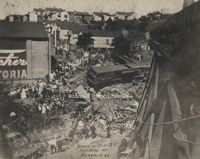
The aftermath of the wreck of the "Ole 97". Due to excessive speed in an attempt to maintain schedule, the train derailed at the Stillhouse Trestle near Danville, Virginia where the train careened off the side of the bridge, killing eleven personnel…
Davis2 47.76 Roanoke Electric Steel
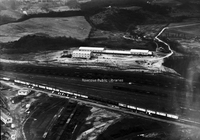
An aerial view of Roanoke Electric Steel, formerly located at 20 30th Street NW.
MP 27.3 Engine 609
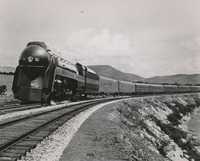
Engine 609 of the Norfolk & Western Railway.
MP 27.2 Engine 604
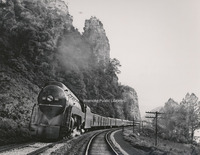
Engine 604 of the Norfolk & Western Railway.
MP 27.1 Engine 601
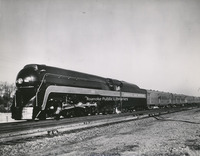
Engine 601 of the Norfolk & Western Railway.
MP 27.0 Engine 2151
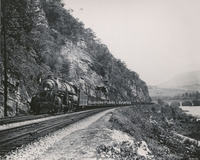
Engine 2151 of Norfolk & Western Railway.
Underwood 19 N&W Yards
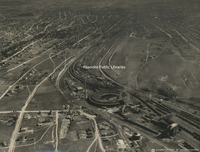
Aerial view of the Norfolk & Western Railway yards.
Davis GL 84 Center Parkway
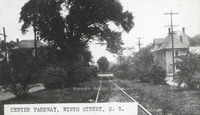
Center Parkway, 9th Street SE.
Davis GL 40 Railway Station
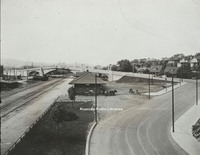
View from Williamson Road of Virginia Railway Station. Jefferson Street bridge in background.
Davis GL 242 Shaffers Crossing
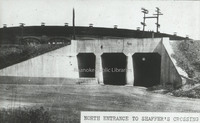
North entrance to Shaffer's Crossing.
Davis GL 237 Walnut Avenue Bridge
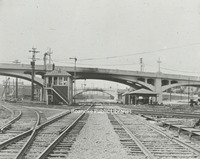
Side view of the Walnut Avenue and Jefferson Street bridges.
Davis2 61.25 Virginian #104
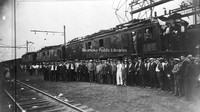
An unidentified group stands in front of Virginian #104, a class EL-#3A electric locomotive.
Davis2 43.214 N&W Offices
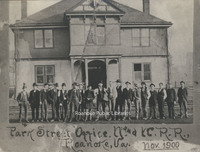
Railroad employees stand in front of the Norfolk & Western Office building formerly located on 5th Street.
Davis 66.811 Franklin Road RW Bridge
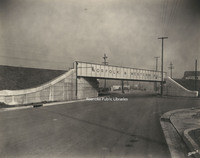
Norfolk & Western railway bridge over Franklin Road.
Davis 66.81 Franklin Road RW Bridge
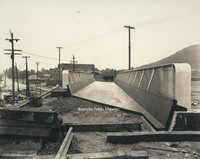
Railway bridge over Franklin Road under construction.
Davis 66.3a Jefferson Street Bridge
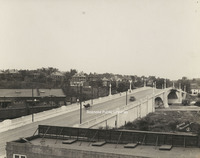
Jefferson Street Bridge was built in 1926
Davis 61d N&W General Offices
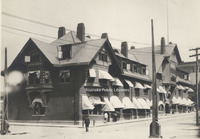
Original Norfolk & Western General Offices, formerly located at the corner of Jefferson Street and Shenandoah Avenue. The building was destroyed by fire on 4 January 1896.
Davis 61b N&W Rails
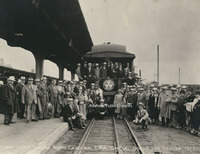
Member of the Travelers Protective Association prepare to leave for Denver.
Davis 61a N&W Rails
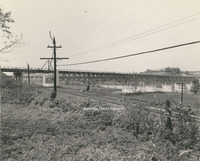
View of Norfolk & Western rails. Southwest Virginia Memorial Bridge crossing the New River in background is under construction.
Davis 61.95 Summer Train Schedule
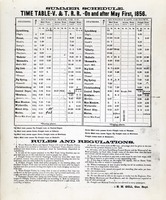
Summer train schedule and timetable for the Virginia & Tennessee Railroad.
Davis 61.71 Thaxton Train Wreck
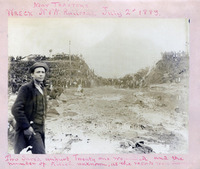
Train wreck on the Norfolk and Western railroad. Twenty one wounded and the number of killed unknown, as the records were destroyed. Man in foreground unidentified
Davis 61.31 N&W Bridge Construction
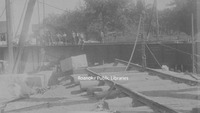
American Bridge and Iron Company constructs a Norfolk & Western bridge over the south branch of the Elizabeth River near Gilmerton.
Davis 61.24 Powhatan Arrow #4
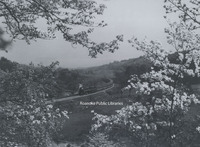
Norfolk & Western Powhatan Arrow Locomotive #4 east of Vinton.
Davis 61.23 N&W Class N Locomotive
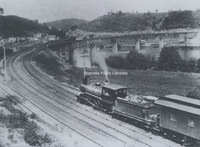
Norfolk and Western Class N passenger locomotive near Radford.
Davis 61.22 N&W Class S1A #244
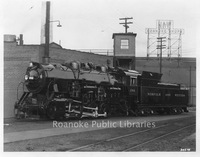
N&W Class S1a #244 locomotive at Roanoke Shops. This was the last locomotive built in Roanoke and the last standard gauge locomotive built in the United States.
Davis 61.2 NW Class Y6b #2189
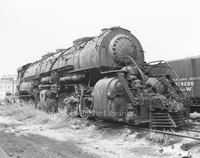
Norfolk & Western Class Y6b #2189 locomotive shown shortly before scrapping at United Scrap Iron and Metal Company.
Davis 61.11 N&W Railroad
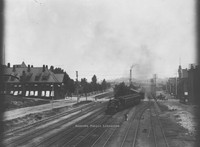
N&W Railroad - View looking east down tracks - N&W General Offices, Hotel Roanoke, and depot at Jefferson Street crossing all visible.
Davis 57.381 Booster Club
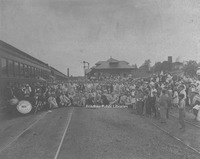
Members of the Roanoke Booster Club.
Davis 45 Roanoke Machine Works

Roanoke Machine Works was founded in 1881. By 1883, the Shenandoah Valley Railroad acquired the facility. Norfolk & Western acquired the facility in 1897. From then on, it became known as the N&W Roanoke Shops. It is still an active maintenance…
Davis 43.213 N&W General Offices

The Norfolk and Western General Offices once stood at the corner of Jefferson Street and 1st Street. The building was destroyed by fire 4 January 1896.
Davis 43.212 N&W General Offices Fire

N&W General Offices fire. Formerly located at the corner of Jefferson and 1st Street, the building was a total loss.
Davis 43.211 Norfolk & Western Office Fires

N&W General Offices fire. Formerly located at the corner of Jefferson and 1st Street, the building was a total loss.
RNC 8 Wilson & Company
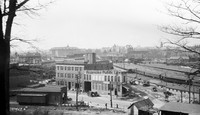
Wilson & Company, seen in the foreground, was a wholesale meat company. It was located at 312 Campebell Avenue SE. Hotel Roanoke and N&W General Offices can be seen in background.