
Browse Items (9249 total)
Sort by:
RVNH4029 Woodrum Field

Looking toward Tinker Mountain from Woodrum Field.
RVNH4028 CAA Tower

A close-up view of the Civil Aviation Authority control tower on top of the Cannaday farmhouse.
RVNH4027 CAA Tower

A Civil Aviation Authority control tower on top of the Cannaday farmhouse at Woodrum Field.
RVNH4026 Mason-Dixon Airlines

A Mason-Dixon Airlines passenger plane at Woodrum Field.
RVNH4024 Yellow Cab

Yellow Cab began offering limousine service on 20 July 1947, under contract with American and Eastern Airlines. Seen next to this Desoto limousine at Woodrum Field at Mae Williams (left) and Margaret Franklin (right).
RVNH4023 Hillcrest House

Hillcrest Hall was one of the dormitories for American Viscose employees.
RVNH4022 American Viscose

An unidentified woman in the reeling room at American Viscose.
RVNH4021 American Viscose

An unidentified man in the reeling room at American Viscose.
RVNH4020 American Viscose

An unidentified woman works with strands of silk at American Viscose.
RVNH4009 Forbes-Hodges Reunion

Forbes-Hodges family reunion in Wirtz, Virginia.
RVNH4008 Wanderers of the Wasteland

Wanderers of the Wasteland musical group. Left to right: Roy Lemmon, Bob Pauley, Glenwood Howell, and Woody "Lucky" Mashburn.
RVNH4007 Dale Avenue

Houses along Dale Avenue SE.
RVNH4006 Southeast

A section of the Southeast neighborhood. Jamison School visible in the background.
RVNH4005 Kiddie Pool

As indicated by the caption, "a Southeast kiddie pool in the back yard with chickens" The child is Roy Minnix.
RVNH4004 Young Men

A group of young men at home located at 926 (later 1100 block) 14th Street SE. Roy Minnix is in the back row, second from right.
RVNH4003 JP Sandlot Football Team

The Jackson Park Sandlot Football Team. Coach Sam Elliott on far right in back row.
RVNH4002 Junior Grocery

A large crowd gathers to view the damage after a fireworks explosion at the Junior Grocery on Franklin Road.
RVNH4001 Junior Grocery

A fireworks explosion leveled the Junior Grocery located at 205 Franklin Road SW. Five people were injured in the explosion.
RNRV54 RC Baseball

Roanoke College baseball team.
RNRV53 RC Football

Roanoke College football team.
RNRV52 Daughters of Liberty

Women on a Daughters of Liberty float, likely for a Liberty Bonds parade.
RNRV51 Henry McGuire

Henry P. McGuire stands in a J.L. Dishong fruit and vegetable wagon.
RNRV50 Campbell Avenue

A streetcar travels along Campbell Avenue near the intersection with Jefferson Street. Terry Building visible at right.
RNRV49 Burrell Memorial

Ambulance in front of Burrell Memorial Hospital. Roanoke's first African-American hospital, Burrell Memorial, was founded in 1915 in a small cottage on Henry Street. It soon outgrew the Henry Street location and moved into the former Alleghany…
RNRV48 Police Officers

Chief of Police W. J. Rigney (front passenger) with other unidentified police officers.
RNRV47 Danmore Family

Mr. and Mrs. Danmore at their home at 413 3rd Street NW.
RNRV46 Blackwell Grocery

J.E. Blackwell Grocery, formerly located at 4 Market Square.
RNRV45 Campbell and Jefferson

A busy day at the intersection of Campbell Avenue and Jefferson Street. The Terry Building is visible in the background.
RNRV44 Streetcar Conductors

Roanoke Railway & Electric streetcar conductors.
RNRV42 N&W Baseball Team

Norfolk & Western baseball team.
RNRV41 N&W Employees

Norfolk & Western employees in front of Norfolk & Western offices.
RNRV40 Eagles Band

Eagles Band.
RNRV39 Auto Tire Shop

Auto Tire Shop, formerly located at 501 2nd Street SW.
RNRV38 Horse and Buggy

Horse and buggy in Downtown Roanoke.
RNRV37 Roanoke Ice

Workers deliver ice for Roanoke Ice Corporation. Roanoke Ice Corportation began operations in 1913 after Consumer Ice Company and Griggs Packing Company.
RNRV36 Enon Baptist

Group photo of members of Enon Baptist Church.
RNRV35 Rockledge Inn

Rockledge Inn on Mill Mountain.
RNRV34 High Street Baptist

Presentation of an auto to Reverend W. E. Lee, of High Street Baptist Church for the church’s 41st anniversary.
RNRV33 Crystal Spring

Crystal Spring reservoir and pump house. Crystal Spring was one of the city's earliest landscaped parks. It was designed and managed by Roanoke Gas and Water Works.
RNRV32 Mountain Park

Shooting gallery, The Thriller roller coaster, and bowling alley at Mountain Park.
RNRV31 W.J. Rigney

W.J. Rigney was Chief of Police for the City of Roanoke from 1919 through 1928. Rigney had been appointed Chief to fill the vacancy caused by the death of former Chief A.H. Griffin.
RNRV30 Beckner Family

Family Photo: Front row, 6th from left Isabell Clingenpeel, 7th from left Carl Steele, 8th from left Helen Clingenpeel, 9th from left Lewis Clingenpeel; Back row, 11th from left John Beckner, 12th from left Jackson Beckner, and 13th from left Ann…
RNRV29 Alma Steele

At left is Alma Beckner Steele with two unidentified women.
RNRV28 Steele Family

Photo of members of the Steele Family. Front row, 3rd from left: Carl Steele; Back row, 3rd from left John Steele, 4th from left Alma Steele. All others unidentified.
RNRV27 Men in Park

Two unidentified men in a park.
RNRV26 Peach Orchard

Three unidentified men in a peach orchard,
RNRV25 Country Drive

Three unidentified men and a little girl pose with a Mitchell automobile.
RNRV24 Wagon

Wagon pulled by oxen travels through an unidentified residential neighborhood.
RNRV23 Views

Looking north from South Roanoke toward Downtown. Tinker Mountain is visible in the background.
RNRV22 Mountain Park

Dance Pavilion and The Thriller roller coaster in Mountain Park.
RNRV21 Market Street

Farmer in wagon pulled by oxen on Market Street.
RNRV20 City Market

Customers peruse the City Market.
RNRV19 Mountain Park

Popcorn stand at Mountain Park. Lillie Solleday on right.
RNRV18 Mountain Park

Check Room and Snack Stand in Mountain Park.
RNRV17 Confederate Veterans

Parade participants for Confederate veterans ride a float through Downtown in conjunction with reunion.
RNRV16 Confederate Veterans

Confederate veterans parade through Downtown in conjunction with reunion.
RNRV15 Confederate Veterans

Confederate veterans parade through Downtown in conjunction with reunion.
RNRV14 Vest Furniture

Vest Furniture Company, formerly located at 109 Campbell Avenue SW. Sid Vest, owner, is pictured in white shirt.
RNRV13 VFW Banquet

Professor Charles Rowe and his Rhythm Boys perform for a Veterans of Foreign Wars banquet at the Hotel Roanoke.
RNRV12 John Gibson Davis

Dr. John Gibson Davis.
RNRV11 Edith Paine

Edith Davis Paine holds an air rifle at the Davis home on Salem Avenue.
RNRV10 Davis Family

Zora and Dr. John G. Davis and children with longtime housekeeper, Vivvie.
RNRV9 Ruth and Edith

Ruth Mason (left) and Edith Davis Paine.
RNRV8 Paine Family

William Henry and Rosa Proffit Paine with children Helen and Robert Edward.
RNRV6 Davis Men

Dr. John Gibson Davis (2nd from right) with his sons Hal, Algie, Fred, John Jr., and Paul. Dr. Davis' sons also became doctors.
RNRV5 Davis Children

Paul, Edith, and Frangie Davis with Frank the horse at Davis home on Salem Avenue.
RNRV4 Paul Davis

Dr. Paul Davis holds his daughter Pauline while on leave during World War I. He was awarded the Croix de Guerre for his service in French hospitals.
RNRV2 McAfee Knob

An unidentified man stands on the rock formation known as McAfee Knob. McAfee Knob is one of the most photographed places on the Appalachian Trail.
RNRV1 Appalachian Power

Group photo of Appalachian Power Company workers in Anawalt, West Virginia to install power lines. Arch Stockton holds rolled blue prints and reins of horse.
BM382

Annie Vest and Helen Williams in front of Oswald L. Williams' Store on Bent Mountain.
HNWR202
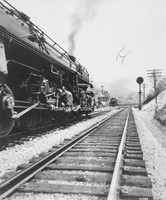
Two N&W locomotives prepare to pass one another heading to and from the West Virginia coal fields.
HNWR199
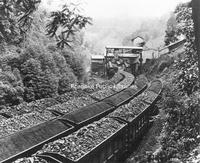
Loaded coal cars awaiting shipment from an N&W coal tipple. Note the different grades of coal being loaded. During World War II, the United States Navy almost exclusively used N&W coal for its Atlantic fleet.
HNWR198
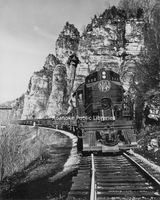
Diesel Engine No. 322 pulls a consist of coal through Virginia. The switch to diesel was difficult for N&W given its commercial investment in coal.
HNWR197
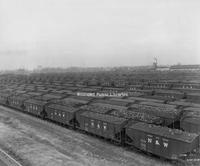
This is the view across the flat yard at Norfolk, Virginia. Hoppers would wait in the yard to be emptied.
HNWR196
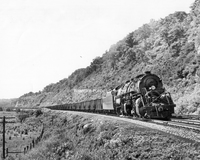
Engine No. 2146 pulls a load of coal. In the 1940s, N&W served the following seven coal districts: Kenova, Thacker, Tug River, Pocahontas, Clinch Valley 1 & 2, and Radford.
HNWR195
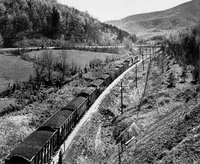
This consist of coal includes some hoppers from the Virginia Railway, which had been acquired by N&W in 1959.
HNWR194
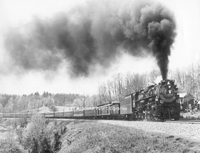
Norfolk & Western's passenger service ceased in 1971. Here is the Pocahontas on her last run, traveling eastbound at Blue Ridge, Virginia. An estimated 100,000 spectators lined the route to catch a glimpse of a passing era.
HNWR193
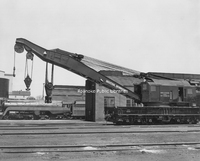
An industrial hoist rests in the yard at Roanoke. Notice the huge pulleys hanging from the arm. Engine No. 131 is in the background.
HNWR192
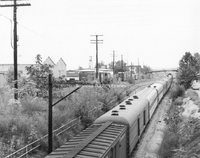
The Birmingham Special moves northbound, having detoured through Waynesboro, Virginia, on account of a washout on the Southern Railway's main line between Monroe, West Virginia and Charlottesville, Virginia. The Special was among a number of other…
HNWR190
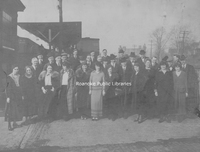
Employees of the Roanoke freight office.
HNWR188
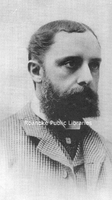
Frederick J. Kimball was one of the most forward-thinking of the early N&W presidents. He was so respected, the citizens of Big Lick voted to change its name to Kimball in his honor. He declined and suggested the location be called Roanoke, which…
HNWR187
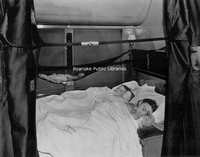
An interior view of a Pullman car after being made into a sleeper.
HNWR186
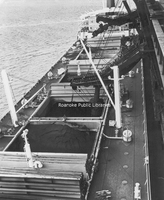
Norfolk & Western always kept a spare for every part necessary to cargo operations.
HNWR185
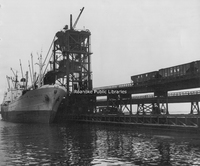
Loaded coal cars await their turn at the car-dumping machine. Upwards of 400 cars of coal are required to fill the large colliers.
HNWR184
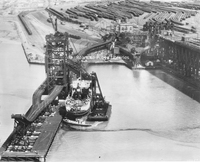
This photograph shows one of the largest loads of coal cargo on a single ship at Lambert's Point. A total of 493 carloads were required.
HNWR183
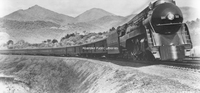
The Class J 600 is pulling a Southern Railway streamlined passenger train. The Class Js were built between 1941 and 1950.
HNWR182
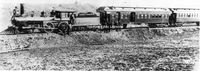
This passenger train stops in Ivanhoe, Virginia. Passenger service would serve as a popular form of distance travel until the emergence of the automobile.
HNWR181

Passenger coach No. 1700.
HNWR180
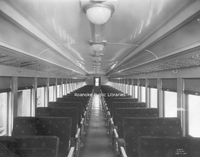
Passenger coaches changed significantly over time. Once elaborate and finely appointed coaches evolved into more basic design, as seen in passenger coach No. 1650.
HNWR179
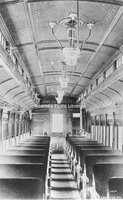
An interior view of a N&W passenger coach. Notice the oil lamps. Although beautiful design features, these lamps would often shatter during an accident, spilling their fuel into the car. Resultant fires sometimes killed more passengers than the…
HNWR178
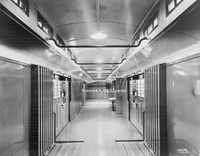
An interior view of an express car used by N&W. Express cars held all kinds of freight, from passenger baggage to commercial merchandise.
HNWR177
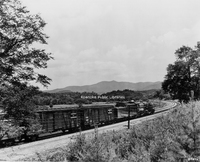
A stock train rolls through the Virginia countryside. As a way to encourage agribusiness, N&W operated a working farm at Ivor, Virginia for some years around 1910-1915.
HNWR176
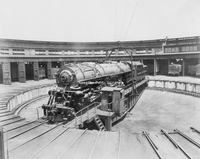
Freight Locomotive No. 1203 rests on the turntable at Shaffer's Crossing in Roanoke.
HNWR175
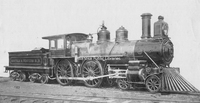
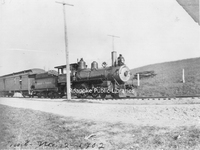
The old Class M engine was built by Baldwin Locomotive Works in 1883. N&W owned two of these engines, Nos. 94 and 95, as shown here.
HNWR174
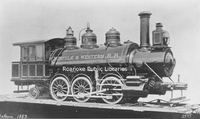
Engine No. 93 was a small shifting engine used at Roanoke Machine Works. It was built by Baldwin Locomotive Works in 1883.
HNWR173
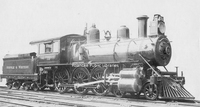
Engine No. 72 is another example of a Class U locomotive built by Baldwin Locomotive Works in 1892. This passenger locomotive weighed in excess of 132,000 pounds and was later converted to simple cylinders.
HNWR172
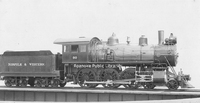
Passenger Engine No. 90 was an example of many engines purchased by N&W in its early years from Baldwin Locomotive Works. Engine No. 90 was a Class A engine.
HNWR170
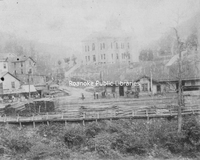
Welch, West Virginia. The old N&W station is in the foreground; the courthouse is atop the hill and businesses are at left.
HNWR168
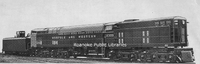
The "Jawn Henry" was the nickname for this combination steam-electric locomotive. It was N&W's last-ditch effort to give steam one last try. The engine had 12 traction motors, weighed in at 1.1 million pounds, and was 161 feet long. Delivered in…
HNWR167
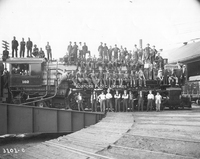
Engine No. 102 rolls out of assembly at the Roanoke Shops and employees pose for the customary photograph of the engine.
HNWR166
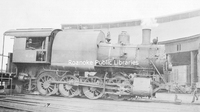
This engine was a Class W-1, 2-8-0 type and was originally built by the Roanoke Shops in October 1900.
HNWR165
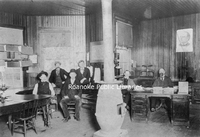
The Portsmouth Freight Office included (from left): L.M. Dory, Gus Kehrer, Fred Dressler, S.R. Crawford, T.M. O'Connor, and Theodore Doty.
HNWR164
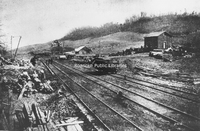
The Bluefield Yard in 1888. In that year, the N&W organized
HNWR163
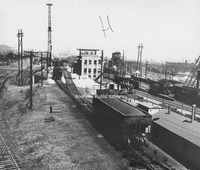
A hopper car loaded with coal coasts down the "hump" incline toward classification tracks at the Portsmouth, Ohio freight yard. This car is half-way through the master retarder. The scale house and assistant yard master's office are located in the…
HNWR162
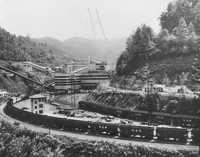
Freight cars line up outside a coal-cleaning and prep plant near Gary, West Virginia. The N&W relied heavily on many of the larger coal mines and facilities throughout West Virginia.
HNWR161
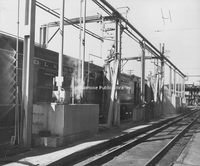
To keep passenger coaches looking good, the railroad regularly sent them through a mechanical washing facility.
HNWR160
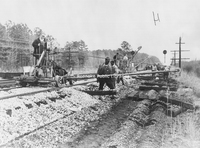
Here is but one example of how mechanization assisted significantly in the maintenance of tracks. A machine removes cross ties for the crew.
HNWR159
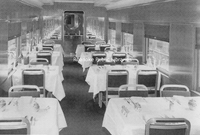
Interior view of a typical N&W dining car.
HNWR158
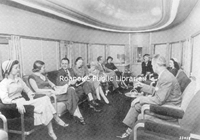
Interior view of a typical N&W lounge car.
HNWR155
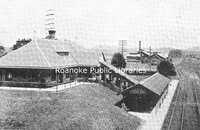
A postcard image of the N&W depot at Salem, Virginia. The depot still remains, although the shed at the tracks was dismantled many years ago. During the 1930s, depots like this dotted the lines of the N&W. Few remain today, either abandoned or in…
HNWR154
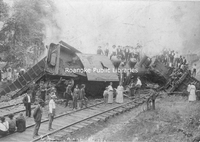
Wreck at Powhatan, West Virginia. Notice the double-tracking in the image. Unfortunately, the development of adequate rail safety technology was years from completion, making railroading a dangerous profession.
HNWR153
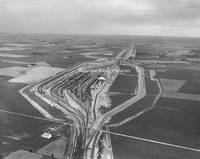
An aerial view of Bellevue Yard in Ohio, looking east. The classification yard is at left center and immediately to the right is the car repair facility. In the distance are the receiving and departure yards.
HNWR152
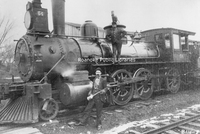
Engine No. 54 with her crew (from left): Engineer E.H. Jones, Fireman Guy Emery, and Conductor Lloyd Pugh. The train was running between Sardinia and Hillsboro branch, and the main line of the Cincinnati, Portsmouth, and Virginia Railroad.
HNWR151
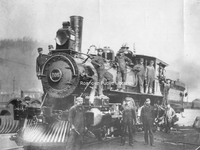
Shop employees and crew of Engine No. 205 in Roanoke, shortly after the locomotives construction.
HNWR150
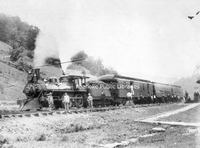
Class Q Engine No. 516 pulls into a depot at Nolan, West Virginia. The engine was originally put into service in April 1882. Crew members are servicing both passenger and express cars.
HNWR149
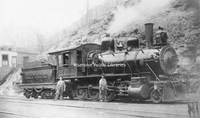
An early example of freight locomotives used by N&W was Engine No. 264.
HNWR148
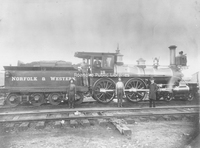
The crew of Engine No. 19. This engine, like most of the engines used by N&W in its infancy, was built by Baldwin Locomotive Works.
HNWR147
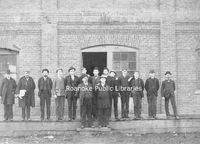
One of N&W's largest freight stations was in Roanoke. Depicted are unidentified freight station employees. The average annual wage for railroad workers in America at the turn of the century was $740, much higher than the average American wage.
HNWR146
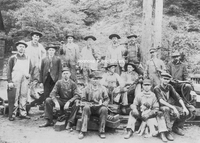
Car yardmen at Kimball, West Virginia. As the coal mines opened, the number of men employeed by N&W soared, bringing economic opportunity to many West Virginia families.
HNWR145
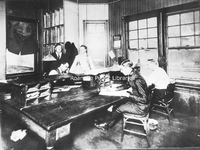
The old car record office at Portsmouth, Virginia. Shown from left are: Floyd Chabot (seated), Paul Jones, S.A. Highfield, H.H. Hester, and John Farley.
HNWR144
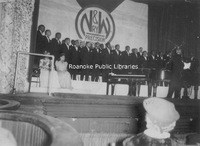
The Norfolk and Western Male Chorus consisted of African American employees who toured and performed hundreds of concerts. Here, the chorus performs at Roanoke's Academy of Music. The chorus was of such a high caliber that one needed an audition to…
HNWR143
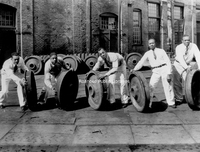
The "Wheel Rollers" of the Roanoke Shops include (front left): Earl Dunning, John Cantry, Charles Wiley, Monk Wiggins, and Thomas Campbell. The Wheel Rollers competed in wheel rolling competitions around the nation and always placed high.
HNWR142
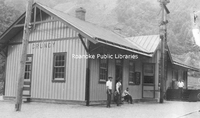
The depot at Grundy, Virginia was reminiscent of many rural depots that lined the tracks of the N&W.
HNWR141
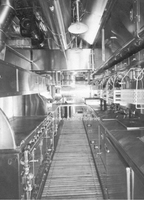
When passenger services encompassed long distances, dining service was offered. While cooks had to operate in a relatively confined space, they prepared full-course meals as good as any fine restaurants.
HNWR140
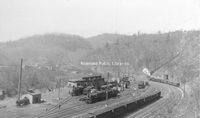
A small coal yard in West Virginia. N&W pioneered and developed the state's coal industry.
HNWR139
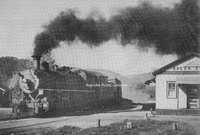
Engine No. 382 runs the steepest grade of all - a sustained three percent grade to the summit at White Top Station. This run, affectionately known as the "Virginia Creeper", ran between Abingdon, Virginia and West Jefferson, North Carolina. Here,…
HNWR138
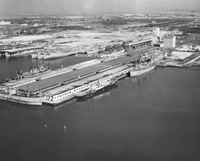
Coal was not the only export transported by N&W. This image shows freight docks and a grain elevator at Sewall's Point at Norfolk. Pier A is in center foreground.
HNWR137
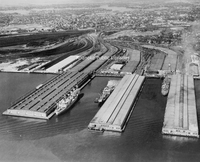
Aerial photograph of N&W freight docks at Lambert's Point near Norfolk.
HNWR136
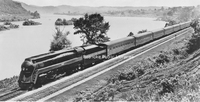
The Powhatan Arrow on one of its runs. The Arrow traveled along a diverse scenic route through Virginia's Dismal Swamp, the Blue Ridge Mountains, the Alleghanies, and into the West Virginia coal fields.
HNWR135
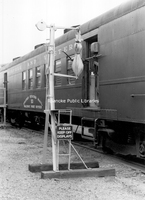
Here, a former N&W mail car is a museum display. Notice the period mail bag hanging from its post. As the train would pass, the mail clerk would position the hook, grab the bag, and then begin the sorting process inside the car.
HNWR134
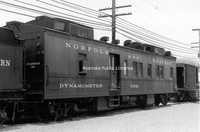
The Dynamometer was pulled by locomotives to determine their actual horsepower and potential speeds. Such calculations were extremely important for effeciently moving freight over different grades and distances. The ability of the locomotive to do…
HNWR133
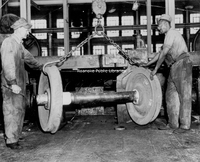
Two employees examine car wheels at the Roanoke Shops. C.G. Wiley is at right; the man at left is unidentified. Unfortunately, African American employees of the N&W could not be promoted beyond entry-level positions until the passage of the Civil…
HNWR132
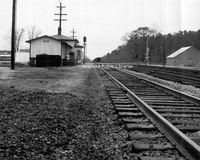
The depot in Ivor, Virginia.
HNWR131
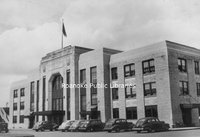
The N&W station at Portsmouth, Ohio.
HNWR129
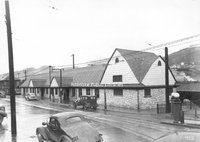
The N&W station at Bluefield, West Virginia.
HNWR128
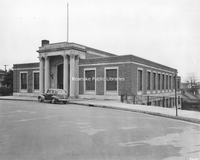
The N&W passenger station at Winston-Salem, North Carolina.
HNWR127
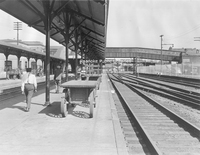
Shown here is the back, lower level of the Roanoke passenger station three years before the Raymond Loewy renovation.
HNWR126
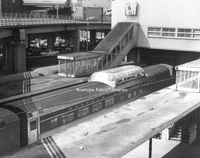
Taken from the Roanoke passenger station, this photograph shows the Birmingham Special in the background and the Pocahontas in the foreground..
HNWR125
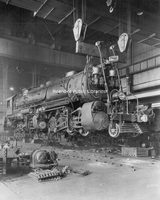
An interior view of the erecting shop at Roanoke showing an engine's assembly in progress.
HNWR124
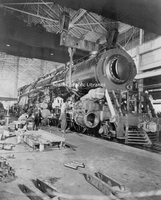
Employees repair an N&W locomotive at the Roanoke Shops.
HNWR123
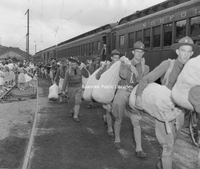
The N&W, like all major railroads, served its country well during World War II for the movement of troops and military freight. In fact, passenger service reached its zenith during wartime. While the exact location of this scene is unknown, it…
HNWR122
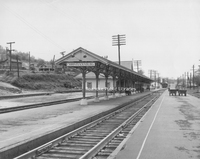
The station at Christiansburg, Virginia awaits freight and passengers. Note the mail and express carts to the right.
HNWR121
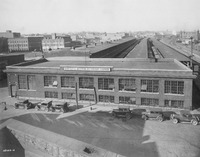
One of the largest freight depots along the N&W line was in Roanoke. Today, the freight depot is home to the Virginia Museum of Transporation, wherein are housed many N&W artifacts and archival material, as well as some steam engines in the outdoor…
HNWR120
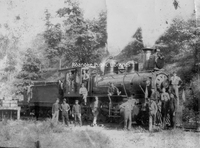
Engine No. 17 is surrounded by rail employees in this photograph taken near Elkton, West Virginia. On the ground at the extreme left is G.W. Pile; standing fourth from the left is H.S. Walker; standing second from the right is C.C. Edmondson; and…
HNWR119
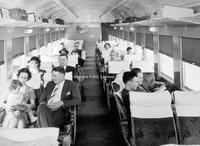
Passengers enjoy a ride on a N&W coach.
HNWR116
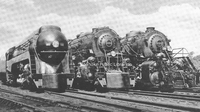
This photograph includes three types of modern, coal-burning steam locomotives designed and built by N&W. These represent the best elements of steam engine design: low initial investment, high utilization, low-cost operation and maintenence, and…
HNWR115
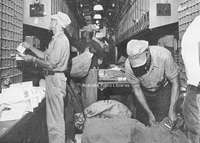
Unidentified men work in a standard rail mail car. The United States Postal Service discontinued use of the railroad post office in 1967.
HNWR114
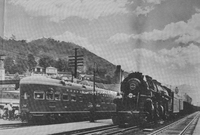
This image symbolizes the commercial ventures of N&W - a coal train enters the picture as a passenger train, the Powhatan Arrow, leaves. Engine No. 1213 is westbound out of Williamson, West Virginia, to deliver coal to the Great Lakes region. The…
HNWR113
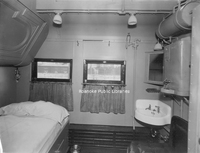
An interior view of a sleeper car.
HNWR112
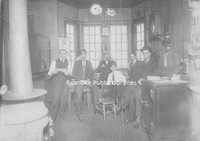
This is an unidentified station office. Pictured left to right are: C.E. Moore, C.C. McPherson, W.L. Bingham, Harvey Call, and W.G. Light.
HNWR111
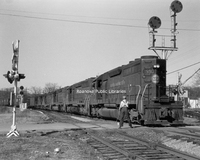
Diesel Engine No. 1590 passes through Buena Vista, Virginia. Notice the train order raised to be grabbed by the engineer as the train passes.
HNWR110
Employees of Roanoke Machine Works build a caboose. They are, left to right: W.E. Meadows, Ted Swain, William Patterson, R.L. Daddow, R.L. Funk, and T.S. Jones.
HNWR109
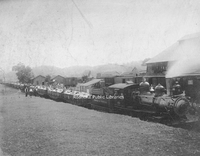
Freight Engine No. 173 of the Radford Yard is depicted at a Radford pipe shop.
HNWR108
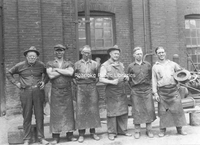
The blacksmith gang at the Bluefield Shops. Blacksmithing was rugged and often dangerous work, but a necessary trade to make the railroad operate. Individuals unidentified.
HNWR107
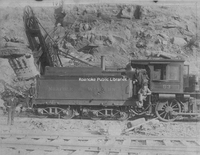
Engine No. 53 and her crew excavate for new track near Bluefield, West Virginia. N&W pioneered and financed early coal production in the mountains of West Virginia and carved the rail beds that allowed the "black gold" to move east.
HNWR105
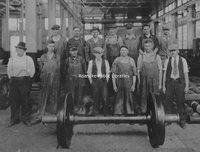
"Roanoke Wheel Shop 1927" is stamped on the axel of the car wheel displayed by the men of the wheel shop. Individuals unidentified.
HNWR104
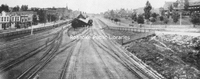
This view shows the early Roanoke passenger station (center),the N&W office building (center right), and the Hotel Roanoke (right).
HNWR102
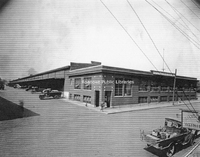
One of the largest freight depots along the N&W line was in Roanoke. Today, the freight depot is home to the Virginia Museum of Transporation, wherein are housed many N&W artifacts and archival material, as well as some steam engines in the outdoor…
HNWR101
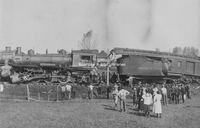
Engines No. 14 and No. 37 collided at Rural Retreat. Note the collapsed front half of the first baggage coach. While engines could often withstand collisions, the wood-constructed baggage and passenger coaches were extremely vulnerable.
HNWR100
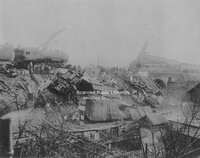
A closer view of the Thaxton wreck shows the debris pile. Engineer Pat Donovan's body was so badly mangled he was only identified by his clothing. The entire woodwork of the train was burned due to exploding gas lights in the coaches. Seven cars…
HNWR099
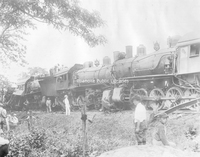
This head-on collision occurred at Rippon, Virginia. Engine No. 481 is at left.
HNWR098
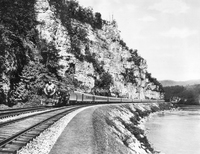
The Pocahontas traveling along the New River. This route was the most spectacular and difficult. After leaving the New River Valley, The Arrow climbed abruptly to Bluefield and then downhill along the Tug River at Williamson.
HNWR097
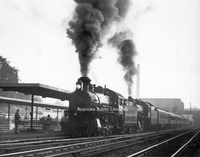
Engine No. 475 steams out of Roanoke. In 1946, the year considered to be the beginning of N&W's modern passenger service, an average ridership per train was 118. By 1971, when N&W discontinued passenger trains, the number had dropped to less than…
HNWR096
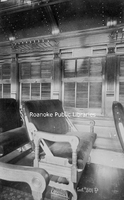
Called a "vestibule car", this interior shot shows passenger seating in an 1892 coach. Notice the window shutters, ornate interior design, and fold-down seats. Despite its comfortable feel, early trains of this era were unsafe and not that pleasant…
HNWR095
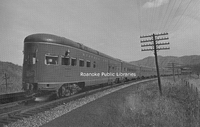
The Powhatan Arrow boasted the finest passenger service amenities when introduced, including a tavern-lounge car. Here the Arrow moves from Roanoke to Bluefield and was photographed at Singer, Virginia. The round-end tavern car, No. 581, allowed…
HNWR094
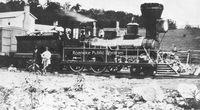
Virginia and Tennessee Railroad named rather than numbered their locomotives. This locomotive was Roanoke. Chartered in 1849 and completed in 1856, the V&T ran from Lynchburg to Bristol and later merged with the AM&O.
HNWR093
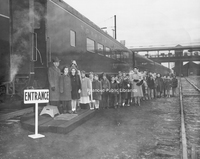
A school group lines up to board the Powhatan Arrow. The name of the train was the result of a contest conducted by N&W, wherein 140,000 entries were submitted. The winner of the $500 first place prize was an N&W retiree, Leonard A. Scott.
HNWR091
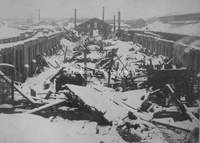
Given the hazards of early railroading, even Mother Nature did not cooperate at times. This image shows a collapsed car shop in Roanoke, a result of a heavy snow storm in 1890.
HNWR090
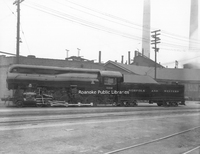
Engine No. 1100, a Class M-2, was one of a number of engines purchased by N&W in 1910. The Class M, as rebuilt, had a 4-8-0 wheel alignment, allowing it to meet the freight demands of the railroad.
HNWR089
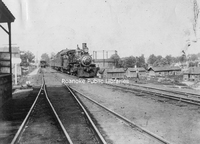
Passenger locomotive No. 29 pulls into the Winston-Salem yard in 1890. This train may have been operating on the former Roanoke and Southern track that was absorbed into the operations of N&W in 1892.
HNWR088
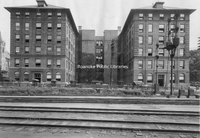
After the first N&W office building burned in 1896, this building took its place. Constructed on the same location as the old, one section was completed in 1896 and the other in 1907. The building is now used for upscale apartments.
HNWR087
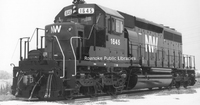
The diesel engine was developed in 1890 by Rudolph Diesel. The Central Railroad of New Jersey was the first to use a diesel locomotive in 1925. It was not until 1955 that N&W began to order diesel locomotives, primarily from American Locomotive…
HNWR086
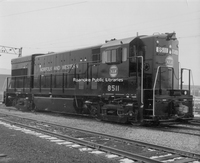
Diesel engines could operate more efficiently than the steam engine and American railroads were quick to make the switch. Between 1941 and 1955, the number of diesel locomotives in use went from 1,200 to 20,000. Pictured is Engine No. 8511.
HNWR085
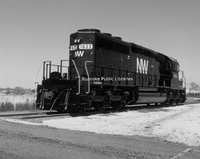
Diesel Engine No. 1633, photographed shortly after being built. Notice the railroad's last corporate logo, the more streamlined "NW". The white-on-black design was introduced by John Fishwick when he was the railroad's president in 1971.
HNWR084
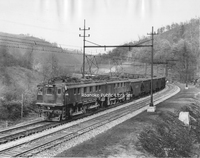
Electric engines were developed in 1914 so crews could safely navigate the tunnel at Coldale, West Virginia. Slow-moving steam engines choked the badly ventilated tunnel to the detriment of the crew's health. The electrified line ran between…
HNWR082
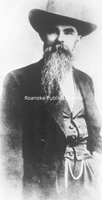
General William Mahone served as the president of the AM&O Railroad for its 10-year existence. Gen. Mahone first gained attention during the Civil War as a field commander, notorious for his unorthodox battle antics. Following the war, Mahone…
HNWR081
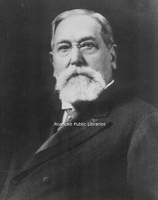
Henry Fink, president of N&W from 1895 until 1902, was the chief operating officer for Mahone's AM&O Railroad. A life-long bachelor, Fink had immigrated to the United States with his brother in 1851 and became a railroad engineer four years later. …
HNWR080
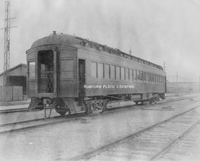
Passenger coaches went through numerous stages of development. From wood to steel construction, and from basic amenities to luxurious accomodations, the coach was designed for both comfort and safety. This is an early passenger coach used by N&W.
HNWR079
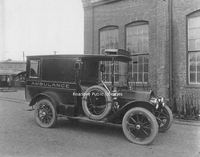
This N&W ambulance from the 1920s signifies the hazards of being a rail worker. In fact, N&W financed the hospital in Roanoke for its first two years of operation so rail families could get necessary medical services.
HNWR078
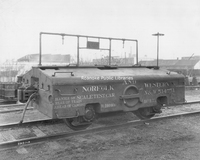
Some "cars" were used for necessary tests to properly maintain a railroad track. One example is the Scaletest Car in this photograph. The car was used to test the scales on the N&W system that weighed the rolling stock. Instructions on the car…
HNWR077
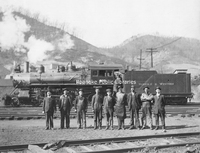
The shop gang of the Portsmouth (Ohio) Shop pose in front of Engine No. 600. In 1901, N&W purchased the Cincinnati, Portsmouth, and Virginia Railroad for $2.5 million. Portsmouth would become a major location in the future operations of N&W.
HNWR076
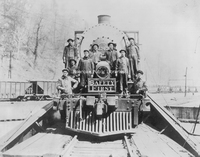
Safety became a paramount concern of the railroad. Pictured is the Eckman Shop Safety Committee on Engine No. 1343. In 1893, Congress passed the Railroad Safety Appliance Act and in 1916, rail employees won Congressional approval for an 8-hour work…
HNWR075
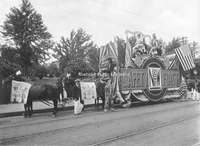
Union Local 440 entered this "Safety First" float in a Roanoke parade. It testifies to the cooperation by rail unions and officials to improve worker safety.
HNWR074
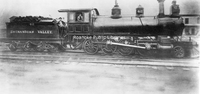
The Shenandoah Valley Railroad operated a 239-mile line from Hagerstown, Maryland to Roanoke, Virginia, which was completed in 1883. Norfolk & Western purchased the railroad in 1890. The Shenandoah Valley's president, Fredercik Kimball, would…
HNWr073
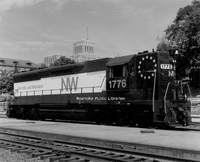
To join the celebration of the nation's bicentennial, N&W painted this diesel locomotive red, white, and blue. The engine's number was appropriately 1776.
HNWR072
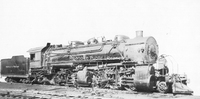
Engine No. 1438 was one of many Class Z-1A engines used by N&W. This particular engine was built in January 1916 in Schenectady, New York. These engines, numbered 1315 through 1438, were built between 1912 and 1917. A number of them were purchased…
HNWR071
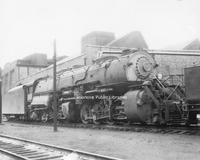
Between 1948 and 1952, 30 Class Y-6B engines were produced by N&W. Engine No. 2200, the last of the Y-6Bs, is shown here at Roanoke.
HNWR070
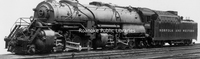
Engine No. 2156
HNWR069
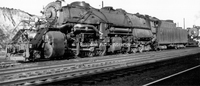
In an effort to heavier freight, N&W developed the Y-6 locomotive. While retaining many of the design elements of the previous Y models, the Y-6 had a new steel frame, roller bearings, and mechanical lubrication at 213 points. A peak horsepower of…
HNWR068
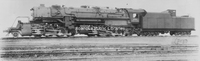
The Class Y-4 engines were developed by N&W in 1927. Only 10 were produced, with Engine No. 2087 among them.
HNWR067
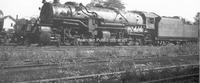
The Class Y-3A engines included No. 2058. These engines, numbering 2050 through 2079, were built in 1923. This photograph was taken in Cincinnati.
HNWR066
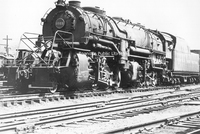
Engine No. 2023 was a Class Y-3 locomotive. This was one of 50 built between 1919 and 1923.
HNWR065
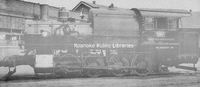
Engine No. 800 was an N&W Class W-6. These engines, numbered 800 through 814, were made between 1898 and 1899.
HNWR064
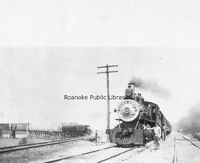
Engine No. 76 was a Class U engine. On the N&W line, these engines were numbered 71 through 85.
HNWR063
Engine No. 37 was a Class N, as were all engines numbered 28 through 37. These engines, purchased by N&W, were made between 1887 and 1888. This photograph was taken at Wakefield, Ohio.
HNWR062
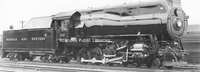
The Class M Engine No. 1112 was built in 1910. Their purchase was almost solely in response to the increased demands for hauling coal.
HNWR061
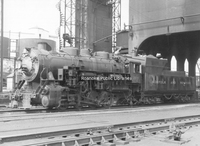
Engine No. 209.
HNWR059
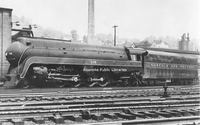
The sleek, Class K-2, Engine No. 118 was acquired by N&W in 1919. These engines, numbering 116 through 125, were rebuilt later and streamlined by N&W.
HNWR058
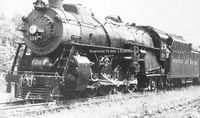
Engine No. 114 was a member of the K-1 Class of N&W locomotives. This class of engine, numbering 100 to 115, was built between 1916 and 1917. The Class K engines were built to pull more weight since new steel passenger cars were replacing those…
HNWR057
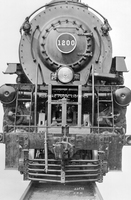
Front view of Engine No. 1200, a Class A built in 1936.
HNWR056
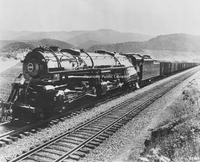
Engine No. 1200. As part of the Class A engines, No. 1200 was the first to be built by N&W between 1936 and 1950. Maximum horsepower was 6,300 at 45 miles per hour.
HNWR055
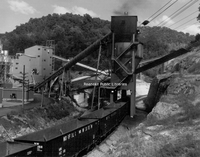
N&W hoppers at a West Virginia coal tipple are loaded for their eastbound trip to Lamberts Point near Norfolk. In 1883, N&W moved nearly 106,000 tons of coal. A century later, N&W moved 75 million tons annually.
HNWR054
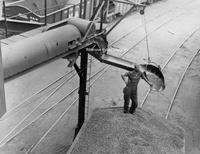
Coal quickly became N&W's leading freight commodity. Here an employee loads an N&W hopper with coal.
HNWR053
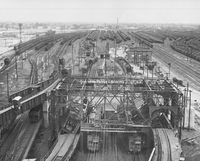
At Coal Pier 4 at Norfolk, hoppers are dumped into pier cars which carry coal to the loading shutes. In the background is a portion of N&W's 12,000 car classification and storage yards.
HNWR052
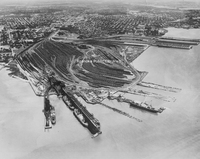
This aerial view shows the N&W coal piers at Lamberts Point. Coal Pier 4 (center) was built in 1914. At the time of its initial construction, the pier was 1,200 feet long, 70 feet wide, and 90 feet above the water. It could empty 600 cars per day.…
HNWR051
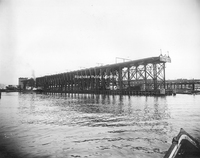
Coal Pier 4 at Lamberts Point. The pier served N&W for nearly half a century.
HNWR050
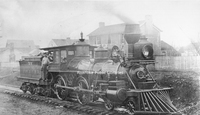
Locomotive No. 37 was used in 1871 when the South Side, Norfolk and Petersburg, and Virginia and Tennessee Railroads were consolidated, forming the Atlantic, Mississippi and Ohio Railroad. The AM&O was the forerunner of N&W.
HNWR049
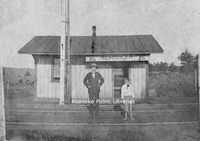
The station at Schooler, Virginia was operated by W.H. Cord (left). The small station operated from March 1883, when coal first began to move from Pocahontas to Norfolk, until 1900 when the station was bypassed by new track. The young man in the…
HNWR048
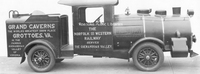
Public relations was not always left to copy editors and high-ranking N&W officials. This photograph shows a "train" built by the men at the Roanoke Shops for advertising purposes.
HNWR046
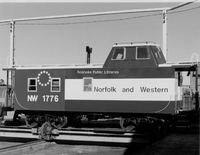
In addition to Engine No. 1776, N&W also had painted certain cars within their rolling stock to highlight the Bicentennial. Here a caboose wears the nation's colors.
HNWR045
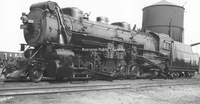
Like many railroads, the lines of the Wabash Railway Company predated the company's formation in 1877. The history of the Wabash is long and complicated, involving certain dubious personalities, mergers, receiverships, and a wavering bottom line. …
HNWR044
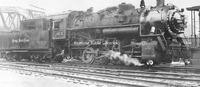
This history of the Nickel Plate Railroad is an amassment of histories from other lines, such as Lake Erie and Western, Clover Leaf, and the Wheeling and Lake Erie. The Nickel Plate was officially the New York, Chicago, and St. Louis Railroad…
HNWR043
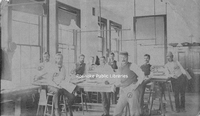
Drawing room employees in the N&W office building. Pictured from left are: John Worthington, Charles Jacobsen, James Woods, Fred Scuiffer, two unidentified, George Worthington, Otis Bellingrodh, Servelius Bisphan.
HNWR042
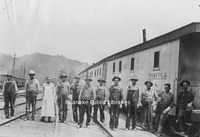
Carpenter Force No. 1, Pocahontas Division at Richlands, Virginia. From left are R.L. Sorah, J.A. Dye, Dayton Henderson, O.J. Lawson, R.L. Maxwell, J.D. Farmer, T.R. Stinson, S.T. Sparks, G.W. Petts, E.W. Clay, A.G. Quillen, R.H. Honaker. Notice…
HNWR041
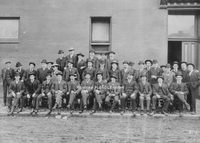
Roanoke Boiler Shop employees at the corner of Salem Avenue and Commerce Street. Pictured from left to right (front row): Frank Bianchi, T.D Equi, John Griffin, P.E. Lawhorn, F.H. Wigmore, George Leisinger, T.J. Murray, James Conway, Edward Irvin,…
HNWR040
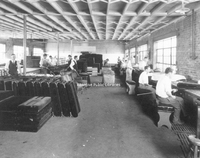
N&W employed a wide variety of skilled laborers. In this photograph, upholsterers in the Roanoke Shops prepare seats for passenger coaches. In addition to outfitting trains, the upholstery shop also fitted office furniture and some items for the…
HNWR039
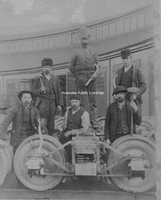
Unidentified employees at the Roanoke roundhouse pose with locomotive wheels. Notice the various tools each is holding, which suggest the different types of work done at the roundhouse.
HNWR038
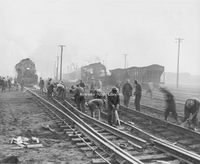
This photograph shows track crews at work along the N&W line. Track laying and maintenance was an awesome undertaking, given the thousands of miles of track owned and operated by N&W. Only in the middle part of the 20th Century did track work…
HNWR037
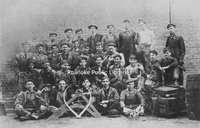
The railroad employed a number of young boys to serve as apprentices during the advent of child labor laws. This photograph shows the Roanoke Shops machinist apprentices. A young apprentice would work a 10 hour day and often overtime on weekends. …
HNWR036
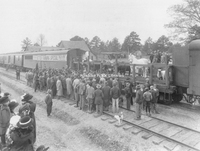
During the first part of the 20th Century, N&W tried to cultivate agricultural products and freight as possible revenue. Rail agents often advertised farmland near N&W depots to encourage such activity. Here a "farm train" stops as men gather…
HNWR035
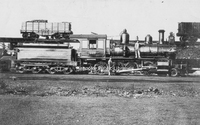
Engine No. 345 was the first compound engine owned by N&W. This photograph was taken at Crewe, Virginia. Crew members include A.D. Lane, engineer, and Julian Hark, fireman.
HNWR034
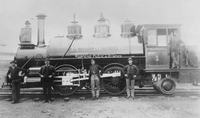
Engine No. 1 was the switching locomotive used at the Roanoke Machine Works (later Roanoke Shops) in 1886. Standing in the cab of the engine is H.S. German. Others, from left, are Brakemen W.H. Hall and W.W. Rule, Engineer Paul DeArmond, and…
HNWR033
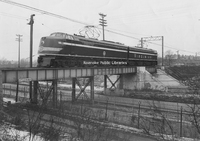
This electric locomotive, Engine No. 126, was from the Virginian Railway. The Virginian was formed by Henry Rogers for $30 million in 1907. Having made his fortune in oil, Rogers died a month after the Virginian was officially formed and his…
HNWR032
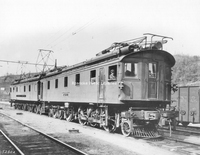
Electric engines acquired by the N&W were from Baldwin-Westinghouse. There were 16 locomotives in all. The system, including overhead catenary wires and a generating plant, was completed in 1916. Engine No. 2506 makes the Bluefield run. In 1950,…
HNWR031
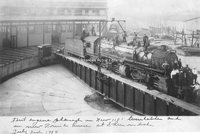
Engine No. 1442 is placed on the new 115-foot turntable and in the new roundhouse of the Shenandoah Division. For this moment, the men of the roundhouse take a break to pose in recognition of achievement.
HNWR030
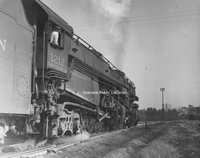
Locomotive No. 1212 pulls a load in a scene of the past: a steam engine at work. The N&W was the last major American railroad to abandon the steam engine in favor of the diesel engine. The designers and engineers of the N&W developed the steam…
HNWR026
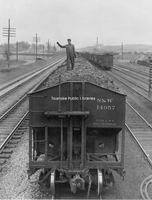
A hopper with coal is ready to go. 1970 was the peak for N&W coal traffic, when the railway carried 90.6 million tons of coal. While coal was profitable, it was not always a source of revenue. Floods, miner strikes, and other labor disputes cut…
HNWR025
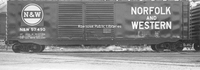
Commonly called the "boxcar", this particular model was used by N&W in 1960. The small numbers along the side under the logo indicated its hauling capacity, weight and load limits, measurements, when it was built, and when it was most recently…
HNWR024
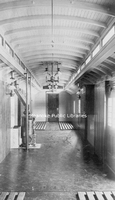
This photograph shows the interior of a 52-foot long baggage and express car built in 1892. Notice the hanging oil lamp and stove at the mid-point.
HNWR023
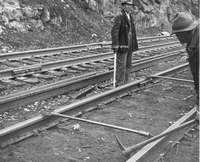
A foreman gauges track to make certain the distance between the rails is exactly 4 feet, 8 inches. In 1883, the N&W operated primarily on a 5-foot gauge; however, on June 1, 1886, the N&W and other southern railroads adopted the now-standard gauge…
HNWR022
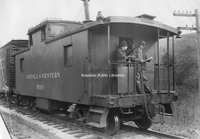
The caboose functioned in may was as the train's office. Often train orders and other paperwork were handled aboard the caboose, which come on the scene in the late 1800s to serve as living quarters as well as an office for the crew. With the…
HNWR021
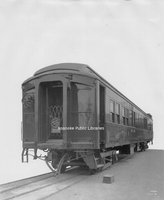
In the late 1920s, the N&W developed a new strategy in rail safety education - the motion picture car. Carrying the "Safety First" logo, the car traveled various rail lines of the N&W as a mobile classroom for the purpose of providing safety…
HNWR020
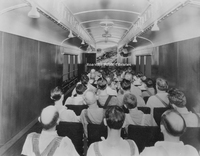
Rail workers watch a safety film inside the N&W's motion picture car.
HNWR019
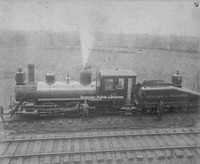
This photograph was taken at east Radford coal wharf. It depicts Engine No. 138 and crew. Mr. Akers, engineer; Charlie Roby, fireman; Mr. Allen and Mr. Adkins.
HNWR016
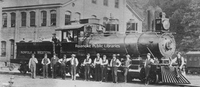
This photograph captures a proud moment in the development of the N&W. Rolled out from the shop is the first locomotive built by Roanoke Machine Works. Roanoke Machine Works would later become the N&W Roanoke Shops. The engine is a Class I.
HNWR014
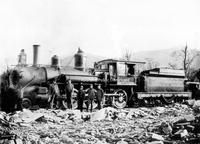
The crew of Engine No. 102, shortly after the engine was taken over by the N&W, included Conductor Lawrence Boyles, Engineer George Agee, Fireman Harley Pugh, and Brakeman Jesse Honaker and R.C. Warden.
HNWR013
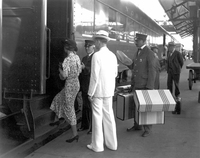
Passengers board an N&W coach. Passenger service when into a steep decline after the mid-1940s. In 1946, for example, the N&W carried 3.4 million passengers. By 1950, that figure was about 900,000. The automobile was taking its toll on the…
HNWR012
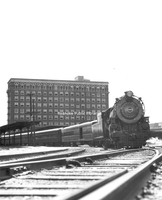
Engine No. 500 pulls out of Norfolk with the Pocahontas. The Pocahontas' maiden run occurred on November 21, 1926, when she ran between Norfolk and Columbus, Ohio. That run replaced the former "Norfolk-Chicago Express".
HNWR011
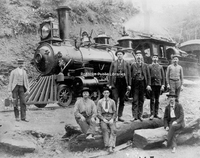
This photograph of the crew of Engine No. 82 was taken when Goodwin, West Virginia was a western terminus. The engine was standing on the Wye track. Crew members are S.D. Clowers, engineer; R.S. Brown, engineer; James Emmons, fireman; George…
HNWR010
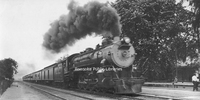
An N&W passenger train speeds between Roanoke and Christiansburg, Virginia. The N&W provided extensive passenger service through southwestern and southeastern Virginia, the Shenandoah Valley, West Virginia, and into parts of North Carolina. With…
HNWR009
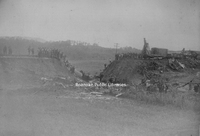
On July 2, 1889, a night storm swelled Wolf Creek near Thaxton, Virginia, which rose out of its banks just as passenger train No. 2 was crossing. The situation became N&W's first major disaster. There was only one survivor, trainmaster James…
HNWR008
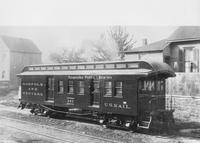
An early N&W mail car. The N&W purchased the car, which was built in 1892. Railroads were a popular and effective way to distribute mail around the country. Clerks aboard the cars would actually cancel the letters en route with the initials RPO,…
HNWR007
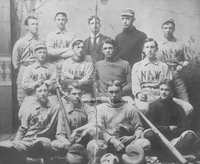
Working for the railroad was not always about work. Here is the 1895 N&W General Office Building Baseball Team. Team members are from left to right: (front row) ? Coleman, Winfree Reed, Max Howe, and G.F. Butler; (middle row) Harry Moore, Garnet…
HNWR006
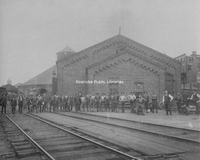
Employees at the N&W roundhouse in Lynchburg. While Lynchburg served as the divisional point for the N&W during its first few years, increased coal and ore traffic caused the N&W to move its divisional points farther west in 1888.
HNWR005
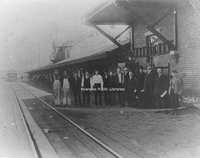
Here is the Old Yard Office located upstairs from the N&W Passenger Station at Radford. Pictured from right to left are Zince, Stump, E.E. Allen, Lawrence Allen, Louis Lucas, Horace Price, Tom Heslep, H.A. Hall, J.C. Turner, O.C. Charlton, J.H.…
HNWR004
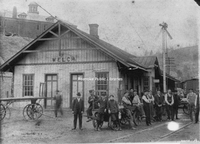
This photograph captures the station and crew at Welch, West Virginia. It is believed that the building in the background is the courthouse. Notice the freight car to the left.
HNWR003
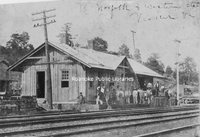
The carpenter crew has almost completed work on the station at Vicker, Virginia in this photo. Carpenters built everything from depots to boxcars and cabooses, to the finished interiors of passenger coaches.
HNWR002
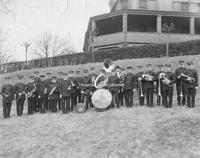
Amongst the clerks, boilermakers, carpenters, mechanics, and engineers were a slew of instrumentalists, singers, song writers, and composers. Together, they formed the Roanoke Shop Band. Here the band stands on the grounds of the Hotel Roanoke. …
SF001 Church Avenue Bus Depot
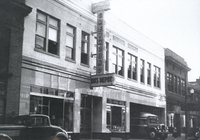
Bus depot, formerly located at 16 West Church Avenue.
PGCC01 Piney Grove Christian Church

Piney Grove Christian Church.The church was located in Roanoke County and was razed in the early 1970s due to the creation/expansion of Route 419. The church was located where the on-ramp is located from 419 to 220 South, near Tanglewood Mall. The…
FC014 Willis High School
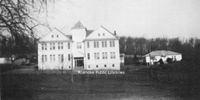
Willis High School. The agricultural building is at right.
FC013 Mountain Normal School
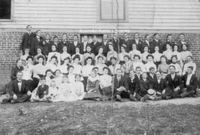
Mountain Normal School students posing in front of the dormitory building.
FC012 Floyd Esso
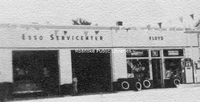
Floyd Esso Service Center in Floyd County.
FC011 Rollie Phillips Store
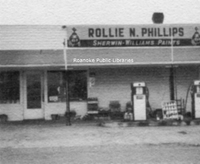
Rollie N. Phillips store and gas station, located in the Indian Valley area of Floyd County. Phillips opened his service station in 1927.
FC010 Willis Elementary School
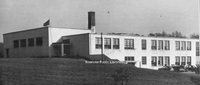
Willis Elementary School.
FC008 Willis High School
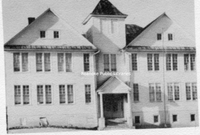
Willis High School after the addition was completed.
FC007 Willis High School
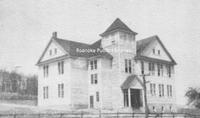
Willis High School shortly after opening.
FC005 WHS Cornerstone
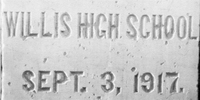
The cornerstone of Willis High School.
FC004 Willis High School
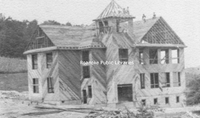
Willis High School under construction.
FC003 Old Mountain Normal
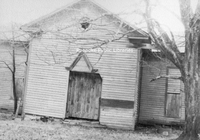
The long abandoned old Mountain Normal School at Willis in Floyd County, VA. The Normal School opened in 1893.
FC002 Mountain Normal School
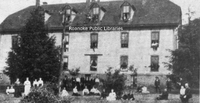
Mountain Normal School dormitory at Willis in Floyd County, VA.
FC001 Willis High School
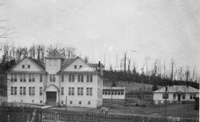
Willis High School in Floyd County, VA. The school closed after the 1961-62 school year.
SHH024 Heironimus Shoppers

Throngs of Christmas shoppers at Heironimus.
SHH020 McGregor Displays

Floor displays at Heironimus for McGregor Menswear
SHH007 Heironimus Float

Heironimus Christmas parade float encouraging children to "Go on the air with Santa" on WSLS.
SHH004 Hara-Kiri Display

Window display at Heironimus for Hara-Kiri robes. Sign reads, "Newest, most popular in Hon. Japanese fashion apparel...authentic ceremonial Hara-robe."
MP 60.2 Peaks of Otter Lodge

Peaks of Otter Lodge
MP 60.1 Peaks of Otter Lodge

Peaks of Otter Lodge in the latter part of construction.
SR190 Bell Telephone

The Bell Telephone Company began service in Roanoke on May 19, 1884. In 1895, Bell Telephone introduced long-distance service. That year Roanokers could call Bedford, Lynchburg and Danville.
SR187 Mountain Stroll

This view shows strollers atop Mill Mountain. The top of the mountain had park grounds and trails and was a popular destination with the incline and the watch tower.
SR186 Martha Washington Candies

This interior view of the Martha Washington Candies store shows what the company considered its “Southern Factory.” Martha Washington Candies Roanoke franchise was started by W.G. Baldwin at 310 S. Jefferson Street in 1914. Mr. Baldwin was of the…
SR184 Scottie's Tavern

Scottie’s Tavern was three miles north of Roanoke on Route 11 and specialized in country ham, chicken and steak dinners. It even offered curb service. J.S. Scott was the manager.
SR183 Keister Home

Sanatoriums were popular at the turn of the last century in the care and treatment of tuberculosis patients. Often doctors or others in the healthcare profession would establish homes and other institutions with such a purpose. Tuberculosis often…
SR180 Memphis Special

“Memphis Special” made its debut through the Roanoke Valley on June 20th, 1909, running between Memphis, Tennessee, and New York City. The Memphis Special remained for years a popular passenger train, being the fastest and most direct route to New…
SR179 Parkway Motel

The Parkway Motel was located on Route 220, just off the Blue Ridge Parkway, three miles south of Roanoke. The card promoted the motel as having “room telephone, air conditioning, all tile baths, hot water heat, air foam mattresses.” The motel was…
SR170 Roanoke College

The Class of 1933 contributed funds for the landscaping and drive that made the “High Street Gateway.” The entrance and subsequent drive were made necessary at the time by the large number of students possessing automobiles as well as increasing…
SR168 Roanoke College

The gymnasium shown here was built in 1930 for a total cost of $138,354. The gym was but one component of a large master plan to expand the college’s facilities. Unfortunately, only the gymnasium was completed on time as the Depression stopped…
SR167 Roanoke College

Smith Hall, named for a past president of the college, was erected in 1941. Designed by the firm of Eubank and Caldwell in Roanoke, the structure (originally a residence hall for forty women) was built and equipped for a total cost of $50,174.
SR162 Bittle Library

Bittle Memorial Library was named for Roanoke College’s early president, Dr. David Bittle. Bittle led the college through its move to Salem and during the Civil War. Bittle was one of three Salem leaders who officially surrendered Salem to the…
SR155 Farmers National Bank

The Farmers National Bank was organized May 8, 1871, with capital of $75,000. Through the leadership of Salem’s prominent businessmen, the bank weathered successfully economic turbulence that put other banks under during the latter part of the 18th…
SR154 Salem Civic Center

Dedicated in 1967 and financed through the sale of bond proceeds, the Salem-Roanoke Valley Civic Center opened as a recreational and cultural center for Salem. Noted historian Norwood Middleton termed this as “the single most talked-about project in…
SR153 Salem Filtration Plant

The filtration plant was an early element in Salem’s water supply infrastructure, but the water supply system itself dated to the 18th century. In 1874, the first concept for a water supply system was advanced to the town council, and in 1875 Salem…
SR152 Municipal Field

The land on which Municipal Field was located had originally been designed for use as an elementary school site. Further study, however, prompted Salem’s leaders to appreciate its use more for athletics. Thus, in the spring of 1932, Municipal Field…
SR150 Andrew Lewis Monument

One of the most notable citizens in the region’s early history was General Andrew Lewis. Though Lewis died before the town of Salem was officially plotted by James Simpson, his life was spent in its general vicinity. This monument was erected in…
SR149 Pierponts Brick Works

Pierpont's Brick Works was owned and operated by Salem businessman George E. Pierpont. In 1908, Pierpont was named as one of the privileged few in Salem to own an automobile.
SR148 Post Office

The construction of a "new" Federal post office on Main Street was a saga of many years. Land purchased by the government in 1917 went undeveloped until 1922 when construction finally commenced. The post office officially opened in June of 1923.
SR147 Hotel Fort Lewis

In 1927, Salem businessman Henry A. Oakey purchased the former Hotel Salem and changed its name to Hotel Fort Lewis. The structure was demolished in 1974 .
SR146 J.J. Newberry

One of the more contemporary establishments was J.J. Newberry Company. The card boasts, “Completely air-conditioned on two large selling floors, approximately ¾ mile counter space carrying over 30,000 separate items of merchandise. A modern…
SR145 Glass Plant

In 1911, the Piedmont Glass Company purchased and resurrected the old glass plant. During the early years, the plant employed some 125 workers who produced glass bottles for a variety of uses. The plant was closed for two months each summer due to…
SR144 Sherwood Burial Park

The Sherwood Burial Park, named for the old “Sherwood” estate that was near the property, was developed on a 35-acre tract in 1928 by C.B. Strickler.
SR137 Lake Spring

The purchaser of this card sent the following message to his brothers: “Your letter received this morning…Father is working for the Virginian R.R. at present…I expect to take an examination for a R.R. mail clerk sometime this fall.” His brothers…
SR136 Homestead Hotel

The Homestead Hotel has a long history. Built by David Wade in 1802, it was formerly known as the Old Globe Tavern with five huge fireplaces and 27-inch thick walls. At the time this card was published, it was the only original stage coach tavern…
SR135 Methodist Episcopal South

This was the sanctuary of the First United Methodist Church congregation from 1904 until 1953. It was located on the northeast corner of College and Clay Avenues.
SR134 Pentecostal Holiness

The congregation of Pentecostal Holiness Church was organized in 1915. Their present sanctuary, shown here, on North Bruffey Street was dedicated in April 1953.
SR133 College Lutheran

College Lutheran Church – This collage shows the various structures associated with College Lutheran. The congregation first met in the Roanoke College chapel (top left) from 1852 until 1858; then they built their first sanctuary (top right) which…
SR132 First Presbyterian

While termed “First” church here, the sanctuary is known as home to the Salem Presbyterian Church located on Main Street. Salem Presbyterian was organized in 1831 and dedicated this sanctuary in 1852. Additions were made in 1914 and 1958.
SR131 Central Methodist

Known originally as the First Methodist Episcopal Church when organized in 1908, the congregation later was called Second Methodist (1939) and then Central Methodist (1954). The sanctuary shown here was consecrated on June 26, 1955.
SR130 Bethel Methodist Episcopal

The Bethel African Methodist Episcopal Church was started in 1870 and at the date of this card’s printing (1912), it stood on the corner of Water Street and Calhoun.
SR128 St. Pauls Episcopal

St. Paul's Episcopal congregation was organized around 1867. The congregation moved a few times before erecting this sanctuary on Main Street in 1911 There have since been numerous acquisitions and additions to the facility.
SR127 Baptist Church

The Salem Baptist Church was organized in 1870 and dedicated their sanctuary at the corner of North Broad Street and College Avenue in 1873. An educational building was added in 1952. The new sanctuary seen today was erected in 1967.
SR126 G.W. Carver

– The George Washington Carver School was opened in the fall of 1940. The construction cost was $125,000. This new school was in response to the deterioration of the Water Street school
SR124 Graded School A

– The “Graded School A” was erected on Water Street as a six-room frame school in 1890-91 (the same year the Academy Street School opened for white students). By 1895, the school had an enrollment of 258 under the principal John Duckwilder.
SR122 Salem High School

The architectural drawing gracing this card was done by G.R. Ragan. The new high school, built on Broad Street, opened in 1912, relieving the overcrowded Academy Street school. Additions followed in 1920 and 1923, but the school was heavily damaged…
SR122 Salem High School

What is now known as the Academy Street School served Salem’s students for many years. The building on the right was constructed in 1890 with an addition (left) coming in 1895. The original portion served the lower grades and the addition became…
SR121 Mount Regis

Tuberculosis sanatoriums were numerous in the first half of the last century. By the late 1960s, tuberculosis was controllable and facilities, such as Mount Regis, were converted to other uses usually health related.
SR120 Mount Regis

Mount Regis was built on Development Hill in South Salem. Mount Regis closed its doors as a sanitorium in 1939. The building was then taken over by the Youth Administration to provide housing for nurses aids in hospitals. After World War II, the…
SR119 Salem

In 1952, residents of South Salem started a petition drive to incorporate a new town, Mount Regis. This was countered by residents desiring annexation into Salem. With some legal maneuverings and posturing, the “Mount Regis” citizens settled down,…
SR117 Fort Lewis

The local chapter of the Daughters of the American Revolution erected in 1927 a monument marking the location of Fort Lewis which had been built by General Andrew Lewis.
SR115 Longwood

The Victorian mansion, known as “Longwood,” was built by Thomas Henry Cooper around 1904. Unfortunately, this majestic structure was destroyed by fire on November 19, 1968.
SR114 Crawford Hotel

This hotel stood on Main Street and was erected by W.D.F. Duval in 1871. It contained 40 to 50 rooms with bath tubs and running water. For a few years, the hotel was owned by the Chapman family and renamed the Lucerne.
SR113 N&W Passenger Station

For many years, Salem had also benefited from passenger service provided by the Virginian Railroad. Virginian passenger service in Salem ended in 1954, five years prior to its merger with the N&W.
SR112 N&W Passenger Station

Passenger service at the Salem depot ended on April 30, 1965. On that day, YWCA kindergartners boarded the Powhatan Arrow for a trip to Christiansburg. That same year, the N&W donated the station to the town of Salem.
SR111 N&W Passenger Station

The N&W Railway donated and created a park near the passenger station in 1933 at College Avenue and 8th Street. The park was one of several that were developed in Salem during that time period.
SR110 N&W Passenger Station

The passenger station hosted a prominent visitor on October 19, 1934, when President Franklin Roosevelt came to dedicate the new Veterans’ Hospital. After the ceremony, the President came to Salem where he was escorted by Salem’s mayor and a cadre…
SR109 Strouse Home

The impressive home of Salem lawyer Demetrius B. Strouse on Broad Street was built around the turn of the last century. Strouse was involved in numerous civic and religious projects in the Roanoke Valley.
SR108 Ridgewood Farm

The Ridgewood farm land is today a developed retail corridor, known as the Ridgewood Village Center. The center opened in 1985 with a variety of stores and restaurants. The home, shown here, remains.
SR107 Monterey

Monterey was the pre-Civil War home of the Chapman family. In later years, the home at the corner of High and Clay served as a hotel, hosting visitors by providing a truly residential flavor.
SR105 Women's Club

The Roanoke County Women’s Club was formed on June 7, 1923, by 28 women. In May of 1929, the club formally dedicated their clubhouse. On year later, the Junior Club added a wing to the main clubhouse and started a library. This effort laid the…
SR104 Lutheran Orphanage

The Lutheran Orphanage sold much of its land holdings in the 1960s to Salem for the purpose of erecting what is now the Salem Civic Center. The buildings were sold in 1985 to Roanoke College.
SR102 Lutheran Orphanage

The Lutheran Orphanage arrived in Salem in May of 1896, occupying a brick home on five acres at the corner of present-day Florida Avenue and Boulevard. The orphanage eventually bought the former Hotel Salem on College Avenue (shown here), which it…
SR101 Baptist Orphanage

Life at the orphanage often paralleled the events within Salem. Some of those were not positive. In 1918, a severe outbreak of the Spanish flu closed Salem’s schools, churches, and businesses for over a month. Sixty children at the Baptist…
SR100 Baptist Orphanage

The residence for the superintendent was constructed within the first decade of the orphanage’s operation. The residence allowed the superintendent to not only live on the campus but to host visitors and families.
SR099 Baptist Orphanage

This second cottage to be built for the orphanage was named for the institution’s first superintendent, the Reverend George J. Hobday, who served from 1891 until 1906.
SR098 Baptist Orphanage

The original 16 acres on which the orphanage sat was donated by businessman John M. Evans. The very first cottage to be built, which was completed on July 1, 1892, was named for the philanthropist.
SR097 Baptist Orphanage

By 1905, the Baptist Orphanage, which was just a decade old, was caring for 165 orphans. Some were placed in the institution’s care due to loss of parents, while others came to live because their families were impoverished. All needs of the…
SR096 Baptist Orphanage

The hill-top Baptist Orphanage prided itself on being self-sustaining in its early years. A generous donation of an additional 87 acres in 1897 allowed the orphanage to even operate a full-scale farm and dairy herd.
SR095 Baptist Orphanage

The cornerstone on the Administration Building was laid on July 4, 1901, becoming occupied in 1902. It’s red-brick castle-like structure was an imposing piece of architecture on the campus. The Administration Building was razed in 1965.
SR094 Baptist Orphanage

Before the advent of modern medicine, quarantine was often the best strategy to avoid the spread of disease. Salem, like all communities, had to impose its fair share of them. In 1905, the Baptist Orphanage was quarantined for two weeks due to an…
SR093 Baptist Orphanage

As a measure of Salem’s hospitality, many of the local churches, regardless of denomination, became involved with both the Baptist and Lutheran orphanages. In fact, Roanoke College offered free tuition to qualified students from both orphanages.
SR092 Baptist Orphanage

The Baptist Orphanage often brought visiting Baptists from around the state to Salem, who, according to the early Salem newspapers, would bring the children into town for entertainment and recreation.
SR090 Courthouse

Judge William Moffett convened the first session of Circuit Court in the new court room on April 1, 1910, and dedicated the day “for the hearing of matters and reading of papers of local historical interest.”
SR088 Courthouse

This photo postcard shows the old county courthouse. The structure was built in 1841 on a lot purchased by Roanoke County from John Gray of Missouri for $400. The courthouse was constructed by Salem hotelier William C. Williams. During the Civil…
SR086 Broad Street

Business leaders in Salem and Roanoke sought to promote their respective communities through a variety of promotional pamphlets. Scenes, such as the one above, were often included to demonstrate progress and prosperity. Salem was labeled as the…
SR085 The Boulevard

For a few years, Salem’s residential streets were segregated. In 1913, Salem created racially segregated residential districts which were permitted by state law. District No. 1 (centered around Water Street) was for blacks, and District No. 2 was…
SR084 College Avenue

Good streets have always been one of the basic services provided by any municipality to its citizens. In 1909, a Salem newspaper headline read, “Good Streets Coming.” The editor was congratulating Salem leaders for applying crushed limestone to the…
SR083 High Street

Salem’s first major population and economic boom occurred between 1880 and 1890 with the development of the railroad. The population during that decade nearly doubled. The Roanoke Collegian reported in 1891, “Building continues, High Street is…
SR081 East Main

After much discussion, Salem’s city fathers agreed to a streetcar route on Main Street (the tracks can be seen in this card) in 1894. The system served Salem and connected riders to the Roanoke line that crossed over Masons Creek. The streetcars…
SR080 East Main

On the back of this postcard was written the following message: “Dear Mama – Does this look like home? Not much, I guess you would like it down here because people are so easy going and don’t believe in working all the time…” Home, by the way, was…
SR079 Main Street

Prominent on the left is a sign for W.B. Dillard Drug Co., Prescription Druggists, Soda and Mineral Waters. Watts Dillard was a prominent Salem business man involved in numerous civic projects. His drugstore, at the corner of Main and College, got…
SR075 Main Street

Dirt streets and horse carriages marked town living one hundred years ago. In the foreground, one can see the outline of a crosswalk, probably brick, that allowed pedestrians to maneuver across streets avoiding ankle-deep mud that often plagued…
SR073 Water Street

Water Street, later South Broad Street, was one of the earliest streets laid out in the 1802 plot of Salem. Water Street became the dominant center for Salem’s African-American community.
SR072 Pennsylvania Avenue

This early street scene illustrates the stately residential developments that marked Salem’s development at the turn of the last century.
SR071 Salem

This century-old view of Salem showed the development of the town since its inception in 1802 by James Simpson when he created 40 lots on 16 acres. The lots fronted one main road which Simpson named “Roanoke Street.” The lots were two sizes,…
SR069 Lakeside

Lakeside survived for over six decades, but the competition brought on by other more major theme parks took its toll. By 1983, the park was in financial trouble. Bought by Charles Fox in 1984, the park was struck by the Flood of 1985. The flood…
SR068 Lakeside

Aunt Katherine wrote her nephew in Salisbury, Maryland, using this card, the following: “How would you like to go in bathing here? Uncle Frank and the boys are in now. It is fresh water. They have slides and swings and acting bars and every kind…
SR067 Lakeside

Lakeside was for many decades the most popular draw for Valley residents and tourists in the region. Offering rides, amusements, recreation, and concerts, Lakeside was complimented by Dixie Caverns, the Blue Ridge Parkway, and being at the…
SR066 Lakeside

This card shows how much the park had developed under the ownership of the Roberts family. This card advertises, “South’s Finest Swimming Pool, Joy Rides for Children and Adults, Beautiful Picnic Grounds.”
SR065 Lakeside

Like most public venues in the South, Lakeside was not integrated until 1964. At about this same time, park owners closed the pool, filled it over, and the park expanded.
SR064 Lakeside

Lakeside survived the Depression by offering low admission prices and cheap entertainment. During World War II, the USO provided servicemen complimentary tickets. There was even a movement in 1958 by nearby residents to constitute themselves as the…
SR062 Lakeside

In 1936, Lakeside was purchased by H.L. Roberts, and his family owned and operated Lakeside for the next fifty years. When the amusement park opened it was described as “the largest pool anyone had ever seen,” complimented by a beach of imported…
SR061 Lakeside

Lakeside was opened in 1920 by Robert Lynn, Sr., and featured a public swimming pool, roller coaster and one additional ride. The original 50-acre tract on which Lakeside was built was an orchard owned by John Bower.
SR059 Camp Powhatan

Camp Powhatan was located in the Natural Bridge National Forest Reserve. Scouting, having reached the States in 1910, has a long history in Roanoke County. The Blue Ridge Mountains Council, No. 599, is headquartered in Roanoke County, having merged…
SR058 Traveltown

The vast majority of tourist homes, motor courts, motels and other tourist-related businesses dried up after the emergence of President Eisenhower’s interstate highway system. Small towns were bypassed, and routes, such as Route 11, were no longer…
SR057 Traveltown

Traveltown, located on Route 11 in Cloverdale, advertised “Every cottage heated with Private Bath.” In the mid-1920s, Route 11 became a link in the Washington-to-San Diego Lee Highway, making it a part of the transcontinental highway system.
SR056 Hanging Rock

The name “Hanging Rock” was given due to the rock formation’s appearance as projecting from the mountainside. In the area of Hanging Rock occurred one of only two Civil War engagements within the bounds of Roanoke County.
SR055 Methodist Church

This Methodist Church was an early sanctuary of the present-day Thrasher Memorial United Methodist Church. The present sanctuary was built in 1963. The church was named for Paul and Sallie Thrasher, pioneer Methodists in the Roanoke Valley. The…
SR054 JC Cook Home

This fine residence belonged to prominent businessman, J.C. Cook originally of Bonsack. Cook later moved to the Vinton area and owned the land on which the Vinton War Memorial was built.
SR053 Vinton War Memorial

The Vinton War Memorial is a tribute to the 29 men of Vinton who gave their lives in military service during World War II and Vietnam. The building, seen here, was dedicated in 1948 as a community center and remains such today.
SR051 Vinton Baptist

Vinton Baptist Church began in 1892. The building shown in this postcard rendering is one constructed in 1924, replacing the original sanctuary of 1894.
SR050 Vinton Roller Mill

Vinton Roller Mills, along Glade Creek, grew out of mills originally built by David Gish that pre-dated the Civil War. By the Twentieth Century, the remaining mill was owned and operated by James Bowie and produced three kinds of flour. By 1924,…
SR047 Ward Haven Camp

This camp was originally constructed in 1933 by the Civilian Conservation Corps. In 1941, it became an Army mechanical training camp. From 1943 until 1946, the camp housed 150 German POWs who worked in nearby orchards. Today, the camp is owned and…
SR046 High Cliffs

The official arrival of the Norfolk and Western Railroad (later Railway) into the Roanoke Valley occurred on June 18, 1882, when an N&W locomotive steamed into the newly-named Town of Roanoke. With the coming of the railroad, the population and…
SR045 Twelve O'Clock Knob

Exactly what road this might be cannot be determined. Historic records, however, show that interest in building a road from Salem across Twelve O’Clock Knob to Back Creek and then up Bent Mountain dated back to 1840.
SR044 Twelve O'Clock Knob

One of the most prominent geographical features in the Roanoke Valley is Twelve O’Clock Knob with an altitude of 2,707 feet. According to local tradition, the mountain received its name prior to the Civil War when slaves, working west of Salem,…
SR043 Enon Baptist

Enon Baptist Church is one of the oldest Baptist churches in the Roanoke Valley. Built in 1855 across from the entrance of present-day Hollins University, the church was established by Charles Cocke, president of Hollins Institute.
SR042 Catawba Sanatorium

This view of the women’s quarters shows the west end of the lean-to with lounging room in the center. Catawba ceased accepting tuberculosis patients on January 1, 1972. When it did, records indicated that some 25,000 tuberculosis patients had…
SR041 Catawba Sanatorium

Catawba Sanatorium developed its own nursing school to train healthcare professionals in the treatment of tuberculosis. Between 1912 and 1954, Catawba School of Nursing graduated 258 Certified Tuberculosis Nurses.
SR039 Catawba Sanatorium

Catawba Sanatorium became in many ways a self-sustaining community. For many years, the sanatorium operated its own dairy farm. The number of patients and employees were such that the area soon had its own post office, school, chapel, and other…
SR038 Catawba Sanatorium

By 1937, Catawba Sanatorium was serving some 340 patients and the grounds totaled over 1100 acres, almost double the acreage contained in the original purchase. The many pavilions, such as the one above, were named for Virginia governors.
SR037 Catawba Sanatorium

When Catawba Sanatorium opened in 1909, it consisted of 42 beds located primarily in the old hotel that served the sulphur springs resort area. The sanatorium would expand in both buildings and number of patients significantly over the next few…
SR036 Catawba Sanatorium

The Virginia Building of Catawba Sanatorium was constructed in 1913, four years after the Catawba Sanatorium opened. The original property for the sanatorium had been the Red Sulphur Springs.
SR035 Hollins College

The infirmary, constructed in 1910, was named for Susanna Cocke. Utilizing Georgian and Federal architecture, the infirmary was actually the first building included in part of new quadrangle on the southeast section of the campus.
SR034 Hollins College

The Bradley Chapel was built in 1883 but not named until the 1930s for Joshua Bradley. The chapel served as the center for campus religious activities. During the early years, Hollins students were expected to attend chapel services daily after…
SR033 Hollins College

Presser Hall was erected in 1925, a gift of Theodore Presser, music publisher. Presser was a music professor at Hollins from 1880 until 1883. Unfortunately, Presser died before the building was completed. At the time of its dedication, the…
SR032 Hollins College

Construction on East Building began in 1856 and was completed two years later. The East Building, complimenting Main and West, completed the quadrangle courtyard. According to early Hollins historians, East was designed to imitate in appearance the…
SR031 Hollins College

The Little Theater was created largely through the spirited giving of Hollins students who, in the 1920s, raised $45,000 toward the total cost of $65,000 for the structure. The theater was built in 1924, replacing an old auditorium that was in the…
SR028 Hollins College

The West Building was totally rebuilt in 1890. The left wing contained the infirmary, doctor’s office and faculty living quarters, and the right wing contained two large halls for Hollins’ two early literary societies. The portico, completed in…
SR027 Hollins College

The 1920s saw the emergence of student leadership in the affairs of the college. In 1920 a student forum was organized for the purpose of providing input on a variety of issues. One reoccurring issue was dress. Could students wear short skirts,…
SR025 Hollins College

The Main Building is one of the oldest structures on the campus. The building was erected in between 1861 and 1863. The day the building was started was the same day Virginia seceded from the Union. With the onslaught of the Civil War,…
SR023 Hollins College

When this postcard was sent, Hollins students were on a reinvigorated academic schedule that covered six days. Students could no longer attend for two years and get an “Academic Certificate.” They now must complete all four years. These academic…
SR022 Hollins College

The sulphur spring on the Hollins campus was discovered in the early 1800s in the bed of Carvins Creek. The message on this card boasted, “Its water has wonderful curative powers, and many prominent men, among them President Andrew Jackson and…
SR021 Hollins College

Early in Hollins’ history, social life for the students was very structured and limited. For example, in 1925 students could receive “gentlemen callers” only on weekend nights and Sunday afternoons. Dates off campus required a chaperone and…
SR020 Hollins College

The “new” bridge shown here was built in 1908, replacing an older one. The bridge was part of an extensive landscape plan developed for the campus at the time that consisted of gardens, boardwalks, bridges and recreational areas.
SR016 Hollins College

The history of Hollins University actually begins in New York with Joshua Bradley, a Baptist minister. Bradley purchased the property of the defunct Roanoke Female Seminary in 1842 for the purpose of forming an education union to “conduct an…
SR015 Falls Near Hollins

Elva wrote to Albert Reinhold on the back of this card the following: “Received your postal from Washington, thank you so very much. Tell your dear mother that I will write to her tomorrow. This is a perfectly grand day to take a walk. Wish you…
SR014 Windsor Court Motel

Windsor Court Motel was at 1908 W. Main Street, Salem. Effie Snead was the owner and, at the time the card was published, Charles Snead was the manager.
SR013 Poole's Motor Court

This motor court was managed by H.R. Poole, who mailed this particular card to Joseph Lang of West Hempstead, NY, with the simple message, “You’re welcome in Virginia.” The establishment lured visitors by claiming “no truck or railroad noise.” Its…
SR012 Goodwin's Motel

The Goodwin Motel’s postcard boasted “approved drinking water.” The motel was located west of Salem on Route 11, which served for many years as the modern-day equivalent of the interstate.
SR011 Fort Lewis Tourist Court

The sender of this postcard wrote, “Will spend New Years Eve here, rained all day, having a good time. This motel is very comfortable. See you in San Francisco.” The Fort Lewis Tourist Courts was ½ mile west of Salem on Route 11.
SR019 St. Charles Hospital

The St. Charles Hospital was located at 533 Mountain Avenue. It opened in March of 1913 under the direction of Dr. J.C. Burke. The hospital closed in 1934, and the building was converted into apartments.
SR018 Roanoke Sanatorium

This card’s description reads, “One of the bedrooms of the Roanoke Sanitarium, Inc. – Institution for the treatment of Nervous and Mental Diseases, Drug and Alcohol Addictions.”
SR017 Belmont Christian

The Belmont section of Roanoke, long-served by the Christian Church there, began as a 40-home development around 1889. The Belmont School opened in 1893 and soon followed street car service (1905), the city’s first automobile fire steamer (1911),…
SR016 First Christian

A member used this card to celebrate her new church sanctuary: “Our new church cost $15,000, pipe organ $2,650, pews $1,100. Expect to dedicate third Sunday in April.” Unfortunately, the church was badly damaged by a fire in 1917, but recovered.
SR015 Belmont Baptist

Belmont Baptist Church was organized on October 17, 1901. They dedicated their second sanctuary in Southeast Roanoke in 1904. Belmont Baptist continues to worship in the sanctuary depicted on this card.
SR014 J.H. Marsteller

J.H. Marsteller created ornate marble monuments and headstones. This card was produced for Marsteller in 1907, showing on the left the exhibit of Marsteller at the 1907 Jamestown Exhibition’s Timber and Mineral Building. The image on the right shows…
SR013 Masonic Temple

The Masonic Temple was located on the northwest corner of 1st and Kirk Street. In 1915, the street level was occupied by Reams, Jones and Blankenship furniture store. The store’s slogan was “Marry the girl – we’ll furnish the home.”
SR012 Jefferson Street

This card shows how Jefferson Street had changed over the years. This view looks north down Jefferson Street from Mountain Avenue, showing a variety of commercial buildings, apartments and hotels.
SR011 View from Incline

The postcard image shows what the vista would have looked like over a century ago atop the famous Mill Mountain Incline. In the bottom foreground is the back side of the old Roanoke Hospital, and in the top distant background one can see the former…
SR010 YMCA

The top image is of the Central YMCA and the bottom image is of the Railroad Department YMCA. The Railroad YMCA opened on November 10, 1903. The Young Men’s Christian Association began in Roanoke in 1883.
SR006 Shenandoah Hospital

Construction of Shenandoah Hospital commenced in 1912, opening the next year. The hospital was located on West Campbell Avenue between 7th and 8th Streets. Dr. J.H. Dunkley was president and assisted by Dr. Ira Huff, Dr. W.S. Slicer, Dr. J.T.…
SR005 Martha Washington Candies

This interior view of the Martha Washington Candies store shows what the company considered its “Southern Factory.” Martha Washington Candies Roanoke franchise was started by W.G. Baldwin at 310 S. Jefferson Street in 1914. Mr. Baldwin was of the…
SR004 Calvary Baptist

The Calvary Baptist Church on Campbell Avenue had as its early sanctuary this beautiful building which was located directly across the street from the present-day facility. Needing more space for the growing congregation and with the completion of…
SR003 Roanoke Times

The Roanoke Times was the first daily paper in Roanoke, having been started by M.A. Claytor in 1886. In 1909, the Times was purchased by J. B. Fishburn, Edward L. Stone, and W.S. Battle and became the Roanoke Times, Incorporated. The Times…
SR002 Jefferson Apartments

The Jefferson Apartments were built in 1912 on South Jefferson Street. The apartments existed for several decades before being razed in the late 1990s. The site of the apartment building was occupied by a house that was moved across Mountain Avenue…
SR001 Virginia Bridge & Iron

The Virginia Bridge and Iron Works began in 1888 as the American Bridge Works, changing its name in 1893. Other branch plants were located in Memphis, Tennessee, and Atlanta, Georgia. The Roanoke Branch was involved in hundreds of bridge projects…
BM 190 Holt's Store

Col. Holt’s store and house on Bent Mountain. Dr. Hurt’s car is parked in front.
BM 138 Bessie and Essie Beckner

Bessie Beckner (left) and Essie Mae Beckner.
BM 381 Poages Mill Baseball

Poages Mill baseball team, #1, R.C. Wertz, #2 O.L. Grisso, #3 John Wertz, #4 Bill Grisso, #5 Ott Wertz, #6 Walt Henry, #7 E.B. Martin, #8 John Bowles, #9 R.C. Henry
BM 380 Marvin Thompson and Guy Conner

Marvin Thompson (sitting on barrel) and Guy Conner in Woodrum Orchard.
BM 379 Cave Spring High
Aerial view of Cave Spring High School and Cave Spring Baptist Church.
BM 378 Cave Spring High

Cave Spring High School
BM 376 George Burris

George M. Burris (right) on a hay wagon, Bent Mountain.
BM 375 Look Out Gift Shop

Roanoke Look Out Gift Shop on Route 221 at the top of Bent Mountain.
BM 374 Bent Mountain

Aerial view of Roanoke Look Out Lodge Gift Shop along Route 221 at the top of Bent Mountain.
BM 373 Mr. and Mrs. Rierson

Mr. and Mrs. Maynard Rierson 50th Wedding Anniversary photo.
BM 372 Rierson Family

Maynard Rierson and family.
BM 371 Riersons Store

Rierson’s Store on Route 221.
BM 367 Riersons Store

Temporary Rierson's Store that was used after old store was razed and before new store was built.
BM 366 Riersons Store

Rierson's Store. This was the original store that stood where Back Creek Elementary School stands today on Route 221.
BM 365 Belleview Primitive Baptist

Belleview Primitive Baptist Church on Roselawn Road.
BM 363 B.G. Finnell

B.G. Finnell, Sr. in front of his store.
BM 362 Finnells Pool

Finnell’s Pool on Route 221, near foot of Bent Mountain.
BM 361 Finnell & Sons

B.G. Finnell & Sons store on Route 221, near foot of Bent Mountain.
BM 360 Conner Family

L to R: Marvin, Jesse, and Betty Conner picking apples in Thompson orchard on Bent Mountain.
BM 359 Mormon Group

Mormon Church Group at Back Creek.
BM 357 Bent Mountain Hunting Club

Bent Mountain Hunting Club. Back row, L to R: Ruben Holt, Dewey Holt, Will Wimmer; Front row, L to R: Ralph Metz, Howard Nichols, Raymond Wimmer
BM 356 Simpson Family

L to R: Nelson Simpson, Omer C. Simpson, Omer C. Simpson Jr., Francis Simpson and unidentified man stacking hay in field. Simpson farm was located on Martins Creek Road.
BM 355 Omer and Francis Simpson

Omer Simpson (right) with son, Francis, cutting hay. Simpson's farm was located on Martins Creek Road.
BM 353 Conner Store

Former store of Clem and Mae Conner along Route 221.
BM 352 Gale Home

Dr. Joseph Gale’s home in Cave Spring, later owned by Dr. White.
BM 351 Gale Office

Dr. Joseph Gale’s office in Cave Spring.
BM 350 Dr. Joseph Gale

Dr. Joseph A. Gale, a physician at Cave Spring in 1880s.
BM 349 Starkey School

Starkey School
BM 348 Laurel Ranch

Vacation cabin at Laurel Ranch.
BM 346 Tinsley Lane

Haystacks along Tinsley Lane.
BM 345 Grisso-Gates School

Grisso-Gates School building, located on property of 5321 S. Roselawn Road in Cave Spring.
BM 343 Starkey Station

Starkey Combination Station.
BM 342 King Brothers Mill

King Brothers’ saw mill, formerly located in the Bottom Creek area. The mill was powered by steam engine. Logs were hauled to the site by oxen and horses.
BM 341 Apple Shed

Marshal Conner’s Bent Mountain Apple Shed produce stand along Route 221 on Bent Mountain.
BM 340 Bent Mountain Hunting Club

Bent Mountain Hunting Club members ready for a hunt, location unknown.
BM 339 Bent Mountain Hunting Club

Bent Mountain Hunting Club cabin on Calloway Road, later burned and was replaced with a cinderblock building. Will Wimmer on far right.
BM 338 Bent Mountain Hunting Club

Unidentified musicians entertain inside clubhouse of Bent Mountain Hunting Club.
BM 337 Bent Mountain Hunting Club

Bent Mountain Hunting Club. The old club building was located on Callaway Road, off of Route 221 just past Blue Ridge Parkway overpass. Standing, L to R: Will Wimmer, C.F. Holt, Walter Overfelt, Dewey Holt, Doug Lancaster, ?, Woodrow Reed, Jake…
BM 336 Will Wimmer

Will Wimmer, a farmer at Bent Mountain.
BM 335 Fletcher Wimmer

Fletcher Wimmer working on family farm. The Wimmers had large cabbage fields. Their farm bordered the Blue Ridge Parkway near the spur road to Bent Mountain.
BM 334 Union 76

Stone’s Union 76 Service Station along Route 221 on Bent Mountain.
BM 333 Ruby and Allen Stone

Ruby and Allen Stone at Union 76 Service Station along Route 221 on Bent Mountain.
BM 328 Fralins Produce

Fralin's Produce along Route 221 on Bent Mountain.
BM 327 Elbe Reed Store

Former Elbe Reed store and Bent Mountain Post Office on Route 221 in process of being razed.
BM 326 Bottom Creek COB

A vacant Bottom Creek Church of the Brethren.
BM 325 Christo Evangelical

A vacant Christo Evangelical Wesleyan Church in the Bottom Creek area.
BM 324 Bent Mountain School

“Old” Bent Mountain School.
BM 322 Allen Stone

Allen Stone, Bent Mountain.
BM 321 Ruby and Allen Stone

Ruby and Allen Stone, Bent Mountain.
BM 320 Poffs Garage

Poff’s Garage, Route 221, Bent Mountain.
BM 319 Ott and Lucy Poage

Ott and Lucy Poage at a dance at Back Creek Elementary School.
BM 318 Cave Spring Baptist

Postcard of Cave Spring Baptist Church, showing parsonage and sanctuary.
BM 317 Henry McGuire

Henry P. McGuire of Cave Spring in J.L. Dishong fruit and vegetable wagon.
BM 316 Preston Hartman

Preston Hartman
BM 315 Hartman Home

Preston Hartman home, Cave Spring.
BM 314 Back Creek Faculty

Back Creek School faculty photo; L to R: Ella Clark Henry, Rufus Henry, Mary Turner.
BM 313 40 Acres

“40 Acres” home postcard, Bent Mountain.
BM 312 Ferguson Family

Roland Ferguson and family in front of their house. The house is located at 5109 Twelve O’Clock Knob Road.
BM 311 Reno Restaurant

Reno Restaurant card, formerly located in Starkey area on Crystal Creek Road.
BM 310 Look Out Lodge

Look Out Lodge postcard, Bent Mountain.
BM 309 Diane Altis

Diane Altis on pick-up in Back Creak area.
BM 308 Altis Family

L to R: Clarence Altis, Mauvieleen Stanley, Ida Stanley, Gaye Stanley. The hill behind them is where the King’s Forest subdivision is today along Route 221.
BM 307 Stanley Family

Stanley Family in snow in the Haran area.
BM 306 Mauvieleen Stanley

Mauvieleen Stanley on Route 221 in area of Haran Baptist Church.
BM 305 Back Creek School

Back Creek School; L to R: Ethel Stump, Mauvieleen Stanley, Lorene Underwood, Martin Tinsley, Arlene Stanley.
BM 304 Stanley Home

House along Route 221, formerly across from Haran Baptist Church.The Stanley Family moved there in 1943. It was razed in late 1960s.
BM 303 Lorene Simpson and Polly Rierson

Lorene Simpson and Polly Rierson.
BM 302 Poages Mill COB

Play at Poages Mill Church of the Brethren; L to R: Eddy Grisso, Curt Mowles, Norvell Hurt, Dick Agee, Daisy Long
BM 301 Back Creek Elementary

Back Creek Elementary School; L to R: Marie Sloan, ?, ?, Gaynelle Simpson, ?
BM 299 John and Virginia Austin

John and Virginia Walters Austin sitting on front porch of home with grandchildren.
BM 298 John Austin

John Philip Austin at his home located across Route 221 from Mt. Union Church of the Brethren. Austin was the first person to have heart by-pass surgery at Roanoke Memorial Hospital.
BM 297 Bent Mountain School

Group at Bent Mountain School.
BM 296 Bent Mountain School

Student group at Bent Mountain School, mostly unidentified, though it does contain Virginia Walters and Cassie Fralin
BM 295 Bent Mountain Faculty

Faculty Group at Bent Mountain School; L to R: Mrs. Lloyd, Mrs. Jones, Mrs. Brook Alderman, ?, Mr. Woods (principal), Ann McGee, Viva Bowles.
BM 294 Reeds Store

Elbe Reed in his store (right) on Route 221. The man at left is unidentified, but possibly a salesman. The store also served as Bent Mountain Post Office.
BM 293 Coles Egg Farm

Snow being plowed at Coles Egg Farm after a big snow on Bent Mountain.
BM 292 Reeds Orchard
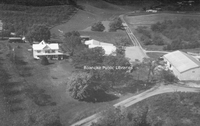
Aerial view of Reed’s Orchard, located at the intersection of Poor Mountain Road and Tinsley Lane. The house was built by the Woodrum Family, bought by Homer Reed in 1948 and closed as a commercial orchard in 1995.
BM 291 Reeds Orchard

Reed’s Orchard operation at intersection of Poor Mountain Road and Tinsley Lane. The apple packing shed in photo was built in 1933.
BM 290 Bent Mountain High

1936 Graduating Class of Bent Mountain High School; Standing, L to R: Raymond Carr, George Powell, Homer Reed; Seated, L to R: Elois King, Margaret Jamison
BM 289 Reed Home

Home of Elbe and Essie Reed, located behind Reed’s Store.
BM 288 Fralins Produce

Fralin’s produce stand along Route 221 on Bent Mountain.
BM 287 Central Baptist

Central Baptist Church, Vacation Bible School. Rev. Arnold Williams is in suit at far left.
BM 286 Harris Home

Harris homeplace along Route 221. It was razed when highway was widened.
BM 285 Alonzo Lockett

Alonzo Lockett in “Dokkie” fez.
BM 284 Callie Lockett

Callie Lockett (nee Harris). She did not cut her hair after age 16, as she thought it sinful to do so.
BM 283 Lockett-Harris Family

Callie Lockett (seated), L to R: Carol Harris, Alonzo Lockett, Hubert Harris, David Harris, Dorothy Harris
BM 282 Hubert Harris

Hubert Harris on Salem Avenue in Downtown Roanoke.
BM 281 Lockett Family

L to R: Alonzo Lockett, Callie Harris Lockett, Pattie Martin at home formerly located across from the old Starkey School.
BM 280 Sarah and Ballard Martin

Sarah and Ballard Martin in front of home. Home is presently located on Shingle Ridge Road, off of Cotton Hill Road. Grandson Damon Martin is in buggy.
BM 279 Ola and Hubert Harris

Ola Agee Harris and Hubert E. Harris lived in the Starkey area.
BM 278 Grant Plaza

Grant Plaza at Cave Spring, located at 3901 Brambleton Avenue.
BM 277 Book Mobile

Roanoke County Book Mobile in front of the Roanoke Count Public Library.
BM 276 Cave Spring Fire Department

Cave Spring Volunteer Fire Department.
BM 274 Luther Bell

Luther Bell, board of supervisors member representing Cave Spring.
BM 272 Reed Family

Enjoying a spin in a Metz car. L to R: Neva, Vera, Elba, Raymond, and Alton Reed.